Showing posts with label neurology. Show all posts

Thursday, October 29, 2015

The Monster Mash – Diseases That May Have Spawned Monster Legends

We’ve all been there. Sick with the flu, we stagger around the house in a feverish state. With our baked minds marinating in a cauldron of cytokines, we can hardly formulate a complete sentence. Droopy-eyed and disheveled, we nearly scare ourselves to death when gazing at the reflection of our barely recognizable self. Terrified out of her diaper, your toddler may even run away from you with a frightful scream. As you’ll learn from the list below, there are several diseases that produce symptoms that mimic characteristics associated with legendary monsters.

Vampires

These blood-sucking creatures of the night are believed to have been inspired by the Romanian Prince Vlad, born in Transylvania in 1431. His father was named Dracul, and Dracula means “son of Dracul”. Dracula was a “defender of the Christian faith” who, ironically, gained notoriety by impaling his victims and dipping his bread in their blood before consuming it.
 
Prince Vlad before dinner (left) and after dinner (right).
 
However, the symptoms of porphyria (yes…it is pronounced poor-FEAR-e-uh!) are likely to have contributed to several aspects of vampire lore. While it sounds like a lost Def Leppard album, porphyria is actually a blood disorder that arises when patients cannot make and regulate heme properly (heme is a critical part of hemoglobin in the blood).

Porphyria can cause excessive nail growth and receding gums, the latter of which may make the canine teeth look more like fangs. Moreover, porphyria can cause skin to bubble and blister just minutes following exposure to sunlight. Look no further than 1985’s cult classic, Fright Night, to witness the awesome power of sunlight destroying a vampire.
 
 
Finally, to make up for the compromised hemoglobin production, the treatment for porphyria involves injecting patients with blood. Despite this parallel with vampirism, people with the disease do not “thirst for blood” or bite others.

Pluto from The Hills Have Eyes

Michael Berryman, best known for his portrayal of Pluto in the 1977 cult classic, The Hills Have Eyes, has an unforgettable appearance. While his role as a deranged desert cannibal haunted the dreams of millions, his character did not require hours in the make-up chair. Rather, his appearance is attributable to a rare genetic condition known as hypohidrotic ectodermal dysplasia. People with this syndrome have fewer sweat glands, sparse body hair, and missing or abnormal teeth. In addition, facial features of these individuals tend to be consistent with those seen in Berryman’s photo below. Other than heat intolerance due to a reduced ability to sweat, people with hypohidrotic ectodermal dysplasia are otherwise healthy.
 
Instantly recognizable on screen, Berryman has appeared in dozens of subsequent roles, including multiple appearances in Star Trek episodes and films.

Werewolves

On the opposite end of the spectrum, people with excessive hair, especially when it appears on the face, have long been attractions at circus sideshows. Perhaps the most famous is Julia Pastrana, also known as “the bearded lady” or “ape woman”, who caught the attention of many onlookers during her travels with “the freak show” in the 1800s. There is a name for this condition, which often resembles the classic appearance of a werewolf:  congenital hypertrichosis lanuginosa, or CHL. Babies born with CHL are usually covered in hair right out of the womb. Today, people afflicted with CHL can elect to have that hair removed with lasers.


“Don’t worry, it’s just a little hypertrichosis flare-up!”


Demonic Possession

Schizophrenia or multiple personality disorders are often cited as likely explanations for people exhibiting unusual behaviors. But an autoimmune disease called “anti-NMDA receptor encephalitis” has been recently described that also produces striking symptoms of demonic possession. A first-hand account of this ailment was written by Susannah Cahalan called, Brain on Fire: My Month of Madness.

 
Incidentally, anti-NMDA receptor encephalitis does not induce the green projectile vomiting made famous in The Exorcist. You have to go to Taco-Bell for that.

Zombies

There are a number of conditions that give people a zombie persona, such as that window of time from waking up till you get some coffee in you. While there is no disease that allows you to persist as an undead, brain-hungry zombie, there is a famous one that can drive animals to bite others:  rabies. Rabies is caused by a virus, and, thanks to Stephen King’s Cujo, most of us are familiar with how rabies can transform a puppy into a hellhound. The virus is plentiful in the salvia of infected animals and is transmitted through a bite or scratch. Many pathogens change the behavior of their host in order to spread. The rabies virus infects the brain in such a way that its host organism becomes overly aggressive, increasing the odds that the virus will be transmitted to a new victim through a bite.

Another type of disorder can lead to an eerie change in behavior with shades of zombification. A rare mental illness called Cotard delusion, or walking corpse syndrome, occurs when the afflicted no longer believe they are alive. First described in 1880 by neurologist Jules Cotard, this “delirium of negation” can run from mild self-loathing to severe depression. In the most extreme cases, the afflicted will deny the existence of certain body parts or their entire body. Consequently, they will stop taking care of themselves, even to the point of starving to death.

 
Marilyn Manson or ‘Cotard delusion’ support group?
 
For some interesting examples of zombification in wildlife, be sure to read Mark’s recent post, “Zombies And The Loss Of Free Will”.


Contributed by:  Bill Sullivan
Follow Bill on Twitter: @wjsullivan

 
Schulenburg-Brand D, Katugampola R, Anstey AV, & Badminton MN (2014). The cutaneous porphyrias. Dermatologic clinics, 32 (3) PMID: 24891059

Deshmukh S, & Prashanth S (2012). Ectodermal dysplasia: a genetic review. International journal of clinical pediatric dentistry, 5 (3), 197-202 PMID: 25206167

Kaur S, Juneja M, Mishra D, & Jain S (2014). Anti-N-methyl-D-aspartate receptor encephalitis: A case report and review of the literature. Journal of pediatric neurosciences, 9 (2), 145-7 PMID: 25250071

Ramirez-Bermudez J, Aguilar-Venegas LC, Crail-Melendez D, Espinola-Nadurille M, Nente F, & Mendez MF (2010). Cotard syndrome in neurological and psychiatric patients. The Journal of neuropsychiatry and clinical neurosciences, 22 (4), 409-16 PMID: 21037126

Thursday, February 12, 2015

Happy Valentine's Day! What Is Love, Anyway?

Many an ‘80s band has pondered the timeless question:  Howard Jones asked “What is Love”, Foreigner lamented “I Want To Know What Love Is”, and both Survivor and Whitesnake wondered “Is This Love”, just to name a few. Recently, a pair of skeletons was discovered in Leicestershire, England, holding hands for the past 700 years. Well, either that or they were thumb-wrestling enthusiasts.

"I wanna hold your hand"
It is hard for us humans to imagine a world without love, but the universe has been going about its business with complete dispassion for billions of years. The appearance of life on Earth did little to change that at first, but after a couple billion years, life forms began to emerge with brains sophisticated enough to make love possible. So it is clear that love is not requisite for life; for every animal that can experience love, there are billions of bacteria living with that animal that do just fine without it.

Many of Earth’s creatures thrive without any need for love.

Granted, bacteria divide asexually, so there is no need to wine and dine a partner who is probably not going to return your 33 calls anyway. You might think that love is needed for sex, but many life forms that have sex, including parasites, plants, insects, and frat boys, do so without love, further begging the question:  why does love exist?

At first sight, love would seem to be counterintuitive to evolution, which is often characterized as the “blind watchmaker” driven by “selfish genes” tinkering to build the fittest survival machine. However, love can confer extraordinary benefits to its practitioners, which is especially important when their offspring are unfit to survive on their own after birth. Most scientists agree that love evolved to prompt species to protect their offspring (this is known as kin selection*), and this altruistic behavior often extends to others who share similar genes. A recent study from April of this year has indeed shown that spouses tend to have similar DNA, and we reported a study a few weeks ago about friends having similar DNA. In other words, an objective analysis reveals that love is a stealthy manipulation orchestrated by selfish genes in order to trick us into protecting their legacy.

Certain dating web sites are capitalizing on the discovery that spouses share highly similar DNA. You can find your genetic soul mate by viewing the genes of potential partners as you check out what they look like in tight jeans.

Back in the 80s we didn’t have technology that could identify our genetically compatible companion, so we had to rely on the wisdom of the great philosopher Sammy Hagar to teach us how we know “When It’s Love”.


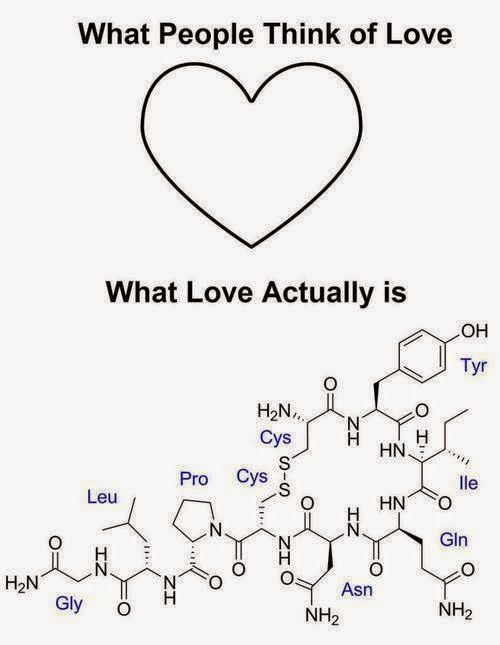
Scientists have also made great strides in elucidating the biochemical basis for love with the discovery of oxytocin, aka the “love hormone” or the “cuddle chemical”, which floods the brain during pair-bonding events, such as sex, childbirth, or eating a Reese's Peanut Butter Cup. In addition to forging pair bonds during sex, oxytocin appears to be instrumental in causing moms to love and care for their kids. Rat mothers given an agent that blocks oxytocin release disregard their newborn pups. There is even a review article on oxytocin written by a Dr. Love – no joke!

Lou Gramm of Foreigner once crooned, “I want to know what love is, I want you to show me.” Here you go, Lou.

So there you have it:  love is an evolutionary tactic that helps us propagate our genetic legacy. Let’s see Barry White work that into a song. It is not the most romantic answer, but remember…just because we know how the roller coaster works doesn’t make the ride any less thrilling.

*It should be noted that kin selection is seen in many species, and not just animals. For example, kin selection is seen in insects and even in plants!
Contributed by:  Bill Sullivan
(heart) Bill on Twitter.


Love TM (2014). Oxytocin, motivation and the role of dopamine. Pharmacology, biochemistry, and behavior, 119, 49-60 PMID: 23850525

van Leengoed E, Kerker E, & Swanson HH (1987). Inhibition of post-partum maternal behaviour in the rat by injecting an oxytocin antagonist into the cerebral ventricles. The Journal of endocrinology, 112 (2), 275-82 PMID: 3819639

Domingue, B., Fletcher, J., Conley, D., & Boardman, J. (2014). Genetic and educational assortative mating among US adults Proceedings of the National Academy of Sciences, 111 (22), 7996-8000 DOI: 10.1073/pnas.1321426111

Friday, January 30, 2015

The Friday Five

Highlighting some of the coolest science news we’ve seen lately.

1. Which will be the best Super Bowl commercial? Science may have the answer!

2. Well, excuse me! It happens to all of us. The science behind brain farts.

3. Twitches, hiccups, yawns, oh my!  The science behind different involuntary behaviors.


Science quote of the week:

“Two things are infinite:  the universe and human stupidity; and I'm not sure about the universe.” –Albert Einstein

Contributed by:  Bill Sullivan
Follow Bill on Twitter: @wjsullivan

Thursday, January 29, 2015

Heaven or Hallucination?

Benjamin Franklin once proclaimed, "In this world nothing can be said to be certain, except death and taxes." While most of us can begrudgingly deal with taxman, we have a much harder time facing the Grim Reaper. It is this fear of the finite that has put the notion of an afterlife at the center of many world religions. Like a good book, we simply don’t want our life's story to end, so most people believe that there must a sequel.

Long ago, people used to think that Heaven was up in the sky. Led Zeppelin even implied that Heaven was accessible via a stairway available for purchase. A more modern idea is that Heaven is transcendental, perhaps in another dimension that is inaccessible to scientific instruments.
What does science have to say on the subject of Heaven and the afterlife? Ancient notions that Heaven resides on mountaintops or in the clouds have been dispelled, and our exploration of the universe so far has not uncovered any evidence of a physical Heaven. The failure to find evidence does not necessarily negate the possibility, but our knowledge about the universe has prompted a change in how most people conceptualize Heaven. Since Heaven is now considered by most to be an ethereal realm unreachable to the living, scientific analyses do not apply and the afterlife must remain a matter of faith.
 
However, some argue that there is tangible evidence of Heaven based on eyewitness accounts of people who've been there during a “near death experience”, or NDE. When evidence is put forth, science is obligated to scrutinize the claim. People surviving a NDE awake with an unshakable feeling that they’ve traveled beyond the confines of their body. You may have heard about the recent case of Alex Malarkey, a young boy who was in an automobile accident in 2004 that left him paralyzed. With the help of his father, they penned a bestselling book in 2010 called, “The Boy Who Came Back From Heaven”. But a couple weeks ago, Alex (now 16 years old) admitted that his story was, um, malarkey. Alex now claims that he made up the whole thing as a child because he “thought it would get him attention”. Consequently, the book has been pulled and the million or so people who purchased it are feeling as deflated as a New England Patriots football.

Rock singer Bryan Adams also once thought he'd died and gone to Heaven.
But turns out he was just love-struck.

We are so eager to feast on these personal accounts of an afterlife that a whole new genre of entertainment has been christened “Heavenly Tourism”. Heavenly Tourism is now a big business, even getting a major motion picture in 2014Some cases appear to bring real credibility to the phenomenon, such as Eben Alexander, M.D., the neurosurgeon who wrote the bestseller “Proof Of Heaven” after his NDE. While science is not a system designed to test matters of faith, researchers can examine what is going on in the brain during NDEs.
Flatliners” was a movie from 1990 about a group of medical students who tried to reproduce NDEs in the lab. The real miracle is that most of these actors were able to resuscitate their career after this movie.
Dr. Steven Laureys heads a Coma Science Group in Belgium that studies NDEs very seriously. His research is revealing that patients who have a NDE form memories during this period that are unusually vivid, feeling “even more real than real”. Dr. Laureys asserts that the lucid nature of these NDE memories fools many people, including Dr. Eben Alexander, to believe they were real events. But Dr. Laureys attributes these powerful experiences to a dysfunctional brain.

According to Dr. Laureys, there is no evidence that consciousness exists independent of brain activity. In other words, patients forming memories during a NDE were not dead, and the images they retain were the natural result of residual brain activity, which can persist for some time even after the heart stops beating. Further evidence that heavenly visions are not real is that they can be reproduced when certain parts of the brain are artificially stimulated. Oliver Sacks has also written extensively about how the stimulation of certain brain areas can produce an array of transcendental experiences that feel absolutely real. Psychedelic drugs can have a similar impact on the brain.

Supportive findings have emerged from studies that record brain activity in dying rats. In rats that would be considered “clinically dead” by human medical standards, researchers observed a surge in specific brain activities that are signatures of “hyper-consciousness”, the same type of phenomenon that Dr. Laureys observes in patients reporting a vivid NDE. 

Neuroscientist Andrew Newberg studies the effects that certain religious practices have on the brain, pioneering a new discipline he calls "neurotheology" that aims to identify the biological underpinnings of spirituality. His studies have revealed why NDEs often leave the impression that you traveled down a tunnel towards a bright light. According to Newberg, peripheral vision is lost during a NDE, producing the sensation that one is in a tunnel.
 

The more we study NDEs, the more it becomes clear that there is a neurochemical basis that explains the imagery and sensations. Collectively, these studies raise a red flag about the validity of Heavenly Tourism, so buyer beware. Those offering to be your tour guide may be teaching you more about neurology and psychology rather than what may await us when the brain truly shuts down. Heaven is outside the realm of scientific examination, so the afterlife remains a matter of faith.

It has been posited, however, that our growing scientific knowledge gives less credence to the supernatural, making an afterlife seem highly improbable. Stephen Hawking has proclaimed, "I regard the brain as a computer which will stop working when its components fail. There is no heaven or afterlife for broken down computers; that is a fairy story for people afraid of the dark." John Lennon once asked us to image no Heaven. While the thought of a finite existence is unfathomable to many, the truth is that the only existence we can be certain of is the one we are living here and now. Embracing the possibility that life is a one-take movie can inspire us to do wondrous things with the time we have alive. Knowing that we will not be reunited with friends and family in the Great Beyond should prompt us to cultivate better relationships with them now. The logical course of action is to treat our life as a fragile and precious commodity, taking good care of the body and mind and enabling others to do the same, which interestingly agrees with the prime directive of most religions. 


Contributed by:  Bill Sullivan
Follow Bill on Twitter.

For more information:
 
Thonnard, M., Charland-Verville, V., Brédart, S., Dehon, H., Ledoux, D., Laureys, S., & Vanhaudenhuyse, A. (2013). Characteristics of Near-Death Experiences Memories as Compared to Real and Imagined Events Memories PLoS ONE, 8 (3) DOI: 10.1371/journal.pone.0057620

Borjigin, J., Lee, U., Liu, T., Pal, D., Huff, S., Klarr, D., Sloboda, J., Hernandez, J., Wang, M., & Mashour, G. (2013). Surge of neurophysiological coherence and connectivity in the dying brain Proceedings of the National Academy of Sciences, 110 (35), 14432-14437 DOI: 10.1073/pnas.1308285110

Newberg AB (2014). The neuroscientific study of spiritual practices. Frontiers in psychology, 5 PMID: 24672504

Blanke, O. (2005). The Out-of-Body Experience: Disturbed Self-Processing at the Temporo-Parietal Junction The Neuroscientist, 11 (1), 16-24 DOI: 10.1177/1073858404270885


Physicist Sean Carroll recently gave a lecture that debunks the notion of an afterlife.

Thursday, November 20, 2014

Science Identifies The Catchiest Songs Ever – Did Your Favorite Make The List?

Humans have a deeply rooted love for music and rhythm. For reasons we’ve yet to fully understand, certain types of music bring out the warrior inside of us while other types of music are incredibly soothing. Some songs move us to tears, yet others make us angry. And humans are not alone their capacity to respond to music. There is something about these unnaturally occurring sound patterns that speaks (sings?) to all species capable of sensing the reverberations.

Music can hold great power over us. Songs can change moods, spark memories, or inspire greatness. Some of you may have seen the video of Henry, an unresponsive gentleman in a nursing home, spring back to life after hearing his favorite music. Watch this remarkable episode below as neurologist Oliver Sacks explains the phenomenon.


We are also attuned to how divergent musical tastes can be! Teens rarely like the music that their parents listen to and vice versa. David Hasselhoff has an inexplicable legion of devoted fans in Germany. Michael Bolton somehow scored multiple hits despite piercing millions of eardrums. Some only listen to country, rap, rock, or classical, yet some people have promiscuous ears that love it all. And, let’s admit it, jazz is only fun for the musicians playing it.

Germans love the music of David Hasselhof so much that they've placed an eerily realistic wax statue of The Hoff by the Brandenburg Gate.
John Mellencamp once declared that the world is “polluted” with songs. With an estimated 2-5 billion songs having been written throughout human history, it is pretty remarkable for one to gain widespread popularity. The songs that manage to stand out from the crowd are typically called “earworms” because they are so catchy that you can’t shake them out of your head no matter how hard you try. Some of these tunes dig their talons so deeply into your subconscious that it can be agonizing; for example, here’s a list of infectious songs that were actually used to torture people.

Recently, Dr. John Ashley Burgoyne, who calls himself a computational musicologist, used an online game called “Hooked on Music” as a tool to identify some of the catchiest songs humans have ever concocted. Want to know what they are?

Coming in at number 5 is the ABBA hit, “SOS”:

The fourth catchiest song is “Just Dance” by Lady Gaga:


“Eye of the Tiger” by Survivor, the theme from Rocky III, punches in at #3:


One-hit wonder Lou Bega swings in at #2 with “Mambo No.5”:


And the catchiest song ever…(fake electronic drumroll)…“Wannabe” by the Spice Girls:


It should be noted that Burgoyne’s research relied on an internet game to generate the list of catchy songs, so there is inherent bias among the participants. Other research that employed a different algorithm (or should that be “algorhythm”?) have, perhaps thankfully, revealed different results.

All the fun aside, there is a serious element to researching why catchy songs are so easily remembered. The scientists involved with these types of studies hope that their work will reveal news insights into learning and memory, which could potentially be useful in treating conditions such as Alzheimer’s disease.
Contributed by:  Bill Sullivan
Snowdon CT, & Teie D (2010). Affective responses in tamarins elicited by species-specific music. Biology letters, 6 (1), 30-2 PMID: 19726444

Thursday, October 23, 2014

The Monster Mash – Diseases That May Have Spawned Monster Legends

We’ve all been there. Sick with the flu, we stagger around the house in a feverish state. With our baked minds marinating in a cauldron of cytokines, we can hardly formulate a complete sentence. Droopy-eyed and disheveled, we nearly scare ourselves to death when gazing at the reflection of our barely recognizable self. Terrified out of her diaper, your toddler may even run away from you with a frightful scream. As you’ll learn from the list below, there are several diseases that produce symptoms that mimic characteristics associated with legendary monsters.

Vampires

These blood-sucking creatures of the night are believed to have been inspired by the Romanian Prince Vlad, born in Transylvania in 1431. His father was named Dracul, and Dracula means “son of Dracul”. Dracula was a “defender of the Christian faith” who, ironically, gained notoriety by impaling his victims and dipping his bread in their blood before consuming it.
 
Prince Vlad before dinner (left) and after dinner (right).
 
However, the symptoms of porphyria (yes…it is pronounced poor-FEAR-e-uh!) are likely to have contributed to several aspects of vampire lore. While it sounds like a lost Def Leppard album, porphyria is actually a blood disorder that arises when patients cannot make and regulate heme properly (heme is a critical part of hemoglobin in the blood).

Porphyria can cause excessive nail growth and receding gums, the latter of which may make the canine teeth look more like fangs. Moreover, porphyria can cause skin to bubble and blister just minutes following exposure to sunlight. Look no further than 1985’s cult classic, Fright Night, to witness the awesome power of sunlight destroying a vampire.


Finally, to make up for the compromised hemoglobin production, the treatment for porphyria involves injecting patients with blood. Despite this parallel with vampirism, people with the disease do not “thirst for blood” or bite others.

Pluto from The Hills Have Eyes

Michael Berryman, best known for his portrayal of Pluto in the 1977 cult classic, The Hills Have Eyes, has an unforgettable appearance. While his role as a deranged desert cannibal haunted the dreams of millions, his character did not require hours in the make-up chair. Rather, his appearance is attributable to a rare genetic condition known as hypohidrotic ectodermal dysplasia. People with this syndrome have fewer sweat glands, sparse body hair, and missing or abnormal teeth. In addition, facial features of these individuals tend to be consistent with those seen in Berryman’s photo below. Other than heat intolerance due to a reduced ability to sweat, people with hypohidrotic ectodermal dysplasia are otherwise healthy.
 
Instantly recognizable on screen, Berryman has appeared in dozens of subsequent roles, including multiple appearances in Star Trek episodes and films.

Werewolves

On the opposite end of the spectrum, people with excessive hair, especially when it appears on the face, have long been attractions at circus sideshows. Perhaps the most famous is Julia Pastrana, also known as “the bearded lady” or “ape woman”, who caught the attention of many onlookers during her travels with “the freak show” in the 1800s. There is a name for this condition, which often resembles the classic appearance of a werewolf:  congenital hypertrichosis lanuginosa, or CHL. Babies born with CHL are usually covered in hair right out of the womb. Today, people afflicted with CHL can elect to have that hair removed with lasers.

“Don’t worry, it’s just a little hypertrichosis flare-up!”

Demonic Possession

Schizophrenia or multiple personality disorders are often cited as likely explanations for people exhibiting unusual behaviors. But an autoimmune disease called “anti-NMDA receptor encephalitis” has been recently described that also produces striking symptoms of demonic possession. A first-hand account of this ailment was written by Susannah Cahalan called, Brain on Fire: My Month of Madness.

 
Incidentally, anti-NMDA receptor encephalitis does not induce the green projectile vomiting made famous in The Exorcist. You have to go to Taco-Bell for that.

Zombies

There are a number of conditions that give people a zombie persona, such as that window of time from waking up till you get some coffee in you. While there is no disease that allows you to persist as an undead, brain-hungry zombie, there is a famous one that can drive animals to bite others:  rabies. Rabies is caused by a virus, and, thanks to Stephen King’s Cujo, most of us are familiar with how rabies can transform a puppy into a hellhound. The virus is plentiful in the salvia of infected animals and is transmitted through a bite or scratch. Many pathogens change the behavior of their host in order to spread. The rabies virus infects the brain in such a way that its host organism becomes overly aggressive, increasing the odds that the virus will be transmitted to a new victim through a bite.

Another type of disorder can lead to an eerie change in behavior with shades of zombification. A rare mental illness called Cotard delusion, or walking corpse syndrome, occurs when the afflicted no longer believe they are alive. First described in 1880 by neurologist Jules Cotard, this “delirium of negation” can run from mild self-loathing to severe depression. In the most extreme cases, the afflicted will deny the existence of certain body parts or their entire body. Consequently, they will stop taking care of themselves, even to the point of starving to death.

 
Marilyn Manson or ‘Cotard delusion’ support group?
 
For some interesting examples of zombification in wildlife, be sure to read Mark’s recent post, “Zombies And The Loss Of Free Will”.


Contributed by:  Bill Sullivan
Follow Bill on Twitter: @wjsullivan

 
Schulenburg-Brand D, Katugampola R, Anstey AV, & Badminton MN (2014). The cutaneous porphyrias. Dermatologic clinics, 32 (3) PMID: 24891059

Deshmukh S, & Prashanth S (2012). Ectodermal dysplasia: a genetic review. International journal of clinical pediatric dentistry, 5 (3), 197-202 PMID: 25206167

Kaur S, Juneja M, Mishra D, & Jain S (2014). Anti-N-methyl-D-aspartate receptor encephalitis: A case report and review of the literature. Journal of pediatric neurosciences, 9 (2), 145-7 PMID: 25250071

Ramirez-Bermudez J, Aguilar-Venegas LC, Crail-Melendez D, Espinola-Nadurille M, Nente F, & Mendez MF (2010). Cotard syndrome in neurological and psychiatric patients. The Journal of neuropsychiatry and clinical neurosciences, 22 (4), 409-16 PMID: 21037126

Friday, October 10, 2014

The Friday Five

Highlighting some of the coolest science news we’ve seen lately.

1. We are one step closer to helping paralyzed people walk again. Neuroscientists in Switzerland are using electronics to restore movement in paralyzed rats – so far, these rats have been able to take 1,000 computer-controlled steps. 


2. The AIDS epidemic gained notoriety in the 1980s, but by using genetics and historical records, scientists have traced the “epidemic ignition” of the HIV virus back to the 1920s in the Congo (called Kinshasa at the time). An excellent piece describing the study is here.

3. Having trouble recognizing the smells coming from the kitchen? Or the flower garden? It could mean your number is up. A new study published in PLoS ONE has found a link between olfactory dysfunction and death.

If something stinks, at least take comfort that you can smell since loss of this sense is a predictor of death!
 
4. Does anything really ever “touch” another thing? Physics says NO! Watch this remarkable video addressing this “touchy” subject:


5. Ever wonder why most people instinctively tilt their head to the right when leaning in for a smooch? Find out the answer to that as you learn “The Scientifically Best Way to Kiss”:


Science quote of the week:

“The first principle is that you must not fool yourself and you are the easiest person to fool.” –Richard P. Feynman


Contributed by:  Bill Sullivan
Follow Bill on Twitter: @wjsullivan

Wenger N, Moraud EM, Raspopovic S, Bonizzato M, DiGiovanna J, Musienko P, Morari M, Micera S, & Courtine G (2014). Closed-loop neuromodulation of spinal sensorimotor circuits controls refined locomotion after complete spinal cord injury. Science translational medicine, 6 (255) PMID: 25253676

Pinto, J., Wroblewski, K., Kern, D., Schumm, L., & McClintock, M. (2014). Olfactory Dysfunction Predicts 5-Year Mortality in Older Adults PLoS ONE, 9 (10) DOI: 10.1371/journal.pone.0107541

Faria, N., Rambaut, A., Suchard, M., Baele, G., Bedford, T., Ward, M., Tatem, A., Sousa, J., Arinaminpathy, N., Pepin, J., Posada, D., Peeters, M., Pybus, O., & Lemey, P. (2014). The early spread and epidemic ignition of HIV-1 in human populations Science, 346 (6205), 56-61 DOI: 10.1126/science.1256739