Showing posts with label sex. Show all posts

Thursday, February 2, 2017

Transgender Boy Scouts

Following a lawsuit, this week the Boy Scouts of America announced that they would begin accepting members based on their gender identity rather than the gender specified on their birth certificate.


For those who do not know any transgender individuals, this might seem ridiculous. You’re either a boy or a girl, just as the doctor called it the day you were born. Consequently, the decision that transgender boys will now be accepted into the Cub Scouts and Boy Scouts has sparked outrage among some people. The outcry, which is often accompanied by shockingly cruel insults (hurled at children, no less), comes largely from folks who assume that sex and gender are the same thing.

For most people, their sex (based on their private parts) matches their gender (whether they feel or “identify” as a boy or girl). But for one in 100 people, there is a mismatch. They may anatomically look like a girl (their sex), but inside they feel like a boy (their gender).

This is not a weak or fleeting feeling to belittle – gender identity can be as strong a feeling in transgender persons as it is in non-transgender persons. The gender the brain assigns overrides whatever genitalia the body possesses.

Gender identity is the brain’s sense of being male or female, regardless of physical appearance.

A transgender boy is born with female parts, but his brain does not identify with that sex. He likes hanging out with the boys and doing typical “boy” things like eating worms off a dare and getting into heated discussions about the quantity and quality of explosions in the latest Michael Bay movie. Despite female genitalia, these children adamantly feel that they are one of the guys.

In a high-profile 2015 interview, Jenner came out as a transgender woman. In Jenner’s own words, “My brain is much more female than male…For all intents and purposes I am a woman…that female side is part of me. It's who I am." Many transgender individuals feel they were born into the wrong body and seek to align it with their gender identity through surgery.

How can this happen? A 2013 study of twins showed that there is a strong genetic component driving transsexuality. Identical twins, who share the same exact DNA, are up to 3x more likely to both be transgender than fraternal (non-identical) twins. This finding argues that genes play a major role in gender identity.

Studies in mice show that disruption of just a single gene can cause females to act like males. Female mice lacking a gene called TRPC2, which is present in brain cells and aids in pheromone recognition, displayed typical sex-crazed male behavior – these females engaged in masculine courtship rituals, pelvic thrusting, and mounting of mates. These female mice also enjoyed burping loudly and watching football with one paw down their pants.

Gender identity may also be under epigenetic control, which means the genes themselves haven’t changed but their expression levels did. One way to dampen a gene’s expression is through a chemical modification called methylation – when DNA is methylated, it represses that gene’s activity.
 
DNA methylation in certain parts of the brain appears to play an important role in the development of gender identity. A remarkable 2015 study showed that a drug that inhibits DNA methylation can make female rats behave like male rats.

Scientists can easily make Minnie Mouse behave more like Mickey by altering genes or gene expression.

Finally, a sophisticated array of hormones influence sexual development and impact the brain. Variations in the genes that manufacture these hormones, or their receptors, could lead to mismatches between sex and gender identity.

This is just a small sampling of the studies confirming that gender and sex are clearly separate - gene variations or changes in gene expression can make the brain assume a gender that is not consistent with the equipment down below. You cannot pick your gender identity any more than you can pick your nose. Wait, let’s rephrase that! You cannot control your gender identity any more than you can control the size of your nose.

Critics have also asserted that children who haven’t hit puberty can’t know that they are transgender. Again, science does not support such a claim. A 2015 study on transgender children has shown that gender identity emerges at a very young age (as early as two years old), and toddlers align with this gender with great conviction. To tell the child otherwise or, worse, to punish the child for acting like the gender they feel they are, can do profound psychological damage to the child’s well-being. In some cases, this has led to debilitating depression and even suicide.

Parents of transgender children are also unjustifiably persecuted, often accused of providing the child with the “wrong” environment or not raising the child the “right” way. However, as we outlined for the children above, no one is at fault here. Experts recommend that parents provide an environment that is consistent with the gender the child feels.

Just like any child, transgender kids deserve an inclusive and nurturing environment, and kudos to the BSA for living up to the Boy Scout Oath “to help other people at all times”, and to be friendly, courteous, and kind.

Contributed by:  Bill Sullivan

Thursday, March 12, 2015

The Last Man And Woman On Earth – Can Two People Repopulate The Planet?

Imagine a virus wipes out everyone on the planet except you. You are free to roam the world and do whatever you please, all in the comfort of your pajamas. No more rules and regulations. No more 9 to 5. You can pick whatever house you want, fill it with priceless artwork, and drive your favorite sports car as fast as you want. That is the concept behind the new television show, “The Last Man on Earth”.


The novelty of being so free does wear off for our protagonist, who soon suffers a level of loneliness that drives him to a suicide attempt. But just before he extinguishes the last XY chromosomes on the planet, he finds the last woman on Earth. A woman who wastes no time in eroding his freedoms, insisting that they use correct grammar and still stop at stop signs.
The lone pair faces the inevitable question:  can they repopulate the Earth? To do so, their children would have to mate with one another, or mom and dad, in order to rebuild the human race. All the incestuous taboos aside, is this even genetically possible?

If just one man and one woman are left to repopulate Earth, then their “family tree” would look more like a family pole.
Inbreeding has unfortunate genetic consequences due to the increased inheritance of recessive genes, which can result in neonatal death. Inbred children that survive are at increased risk of congenital birth defects, reduced fertility, smaller size, immune deficiencies, cystic fibrosis, and more. These defects are also likely to be passed on to their children as well.


If you’ve ever seen The Jerry Springer Show, you know what happens when two closely related individuals start dating. A whole bunch of pushing and shoving! While the show frequently pokes fun at incestuous relationships, it doesn’t emphasize the catastrophic consequences that may befall inbred children.
Some real-life examples of the consequences of inbreeding can be found in places where there are restricted breeding opportunities – for example, within monarchies, islanders, or closed societies. Hemophilia was notoriously prevalent in European royal families. Some Amish societies have a larger number of children born with extra digits on their hands or feet. Jews of Eastern European descent tend to have higher rates of a number of genetic diseases, including cystic fibrosis.
To understand why children of incestuous mating are often plagued by these rare diseases and disorders, we need to review some genetics. For each gene in our 46 chromosomes, we actually possess two copies called alleles – one came from mom, the other from dad. Alleles can be dominant or recessive, the former being expressed while the latter is not. So if you have a bad gene, it could be masked if you have a dominant allele; in other words, you would not exhibit that trait but you would be a carrier. If you mate with someone who also has a recessive allele for that gene, there is a chance your child will be born with two copies of the recessive allele. Such a child would exhibit that gene defect.

Dominant and recessive alleles at work. As a simple example, pretend the trait under study here is lactose intolerance and the bad allele is shown in yellow (the good allele is green). In this example, mom and dad are heterozygous for this lactose intolerance gene – they have one good allele and one bad. Consequently, they can enjoy all the dairy they want because they are only carriers. Their children get one allele from mom and one from dad and can be unaffected (hitting the lottery and getting two good alleles), carriers like mom and dad, or lactose intolerant (losing the lottery and getting both bad alleles).
 
The net result of inbreeding is that the resulting population loses a diverse genetic portfolio, which means they are less resistant to rare diseases and deformities. The smaller the gene pool, the faster it gets dirty. Such individuals would also have less diverse immune systems, making it much easier for a single germ to wipe them all out. That would be an ironic twist of fate since there was something peculiar in the genomes of the last man and woman that kept them alive during the mass extinction!

In addition to the genetic landmines, the family would likely have a very difficult time overcoming the innate resistance most species have against inbreeding. Evolution knows that inbreeding is not good for the species, so it engineered a built-in “incest taboo” that creates a strong aversion to such behavior. A devil’s advocate, however, could argue that the biological barrier to familial sex could be overcome through artificial insemination.

What about using a sperm bank? Sperm is stored in liquid nitrogen, so it would stay frozen for a short time after the power goes out. However, you’d have to act fast because no one is around to monitor the storage tanks and top off the liquid nitrogen as it evaporates.

There are practical concerns to consider as well. The last man and woman, as well as their kids, would need to have large numbers of children and, unless one of the founders happens to be a doctor, it is hard to imagine many of these babies surviving in such a world. Even if they (and mom) survive childbirth, there are countless opportunities for them to perish in this type of environment before reaching childrearing age.
Considering the collective evidence, it seems virtually impossible that just two people could repopulate the planet. But that doesn’t make The Last Man on Earth any less fun to watch.

How many people are required to sustain a human population is an intriguing question that has not been settled. One study estimates that only 70 people who crossed the Bering land bridge 14,000 years ago successfully populated North America.
 
Contributed by:  Bill Sullivan
Follow Bill on Twitter.

Alkuraya FS (2012). Discovery of rare homozygous mutations from studies of consanguineous pedigrees. Current protocols in human genetics / editorial board, Jonathan L. Haines ... [et al.], Chapter 6 PMID: 23074070

Hey J (2005). On the number of New World founders: a population genetic portrait of the peopling of the Americas. PLoS biology, 3 (6) PMID: 15898833

Friday, October 24, 2014

The Friday Five

Highlighting some of the coolest science news we’ve seen lately.

1. We recently reported on the usage of stem cells to produce insulin. A new study published in the Lancet shows that injection of stem cells into the eyes of nearly blind patients helped improve vision in several of them.

2. A paralyzed man has been able to walk again after a pioneering therapy that involved transplanting cells from his nasal cavity into his spinal cord.

Scientists did the reverse experiment and made his nose run!

3. We live in a sea of information and “scientific studies”. How can you tell the good ones from the bogus ones? Here are some good rules of thumb, even if you do not have a background in science.


4. Sex has been around a long time, but sex that involved one member of the species penetrating another is now thought to have appeared about 385 million years ago in Scotland among armored fish called Microbrachius dicki (of course). You can read about the study here and even watch an imagination of the fish sex below (it doesn't take long...they're Scottish after all!).


5. Did all of that ancient fish sex get you overheated? Cool off now with some crazy (but risky!) experiments you can do with dry ice.


BONUS!
In our ongoing coverage of celebrities getting newly found organisms named after them, here is the latest:  a new species of tarantula from South America was named Bumba lennoni to commemorate John Lennon.

Science quote of the week:
“Captain, the most elementary and valuable statement in science, the beginning of wisdom, is, ‘I do not know’.” -- Lt.Cmdr. Data, Star Trek The Next Generation

Contributed by:  Bill Sullivan
Follow Bill on Twitter: @wjsullivan
 
Schwartz, S., Regillo, C., Lam, B., Eliott, D., Rosenfeld, P., Gregori, N., Hubschman, J., Davis, J., Heilwell, G., Spirn, M., Maguire, J., Gay, R., Bateman, J., Ostrick, R., Morris, D., Vincent, M., Anglade, E., Del Priore, L., & Lanza, R. (2014). Human embryonic stem cell-derived retinal pigment epithelium in patients with age-related macular degeneration and Stargardt's macular dystrophy: follow-up of two open-label phase 1/2 studies The Lancet DOI: 10.1016/S0140-6736(14)61376-3

Long, J., Mark-Kurik, E., Johanson, Z., Lee, M., Young, G., Min, Z., Ahlberg, P., Newman, M., Jones, R., Blaauwen, J., Choo, B., & Trinajstic, K. (2014). Copulation in antiarch placoderms and the origin of gnathostome internal fertilization Nature DOI: 10.1038/nature13825

Perez-Miles, F., Bragio Bonaldo, A., & Miglio, L. (2014). Bumba, a replacement name for Maraca Pérez-Miles, 2005 and Bumba lennoni, a new tarantula species from western Amazonia (Araneae, Theraphosidae, Theraphosinae) ZooKeys, 448, 1-8 DOI: 10.3897/zookeys.448.7920

Wednesday, October 1, 2014

What Is Love, Anyway?

Many an ‘80s band has pondered the timeless question:  Howard Jones asked “What is Love”, Foreigner lamented “I Want To Know What Love Is”, and both Survivor and Whitesnake wondered “Is This Love”, just to name a few. Recently, a pair of skeletons was discovered in Leicestershire, England, holding hands for the past 700 years. Well, either that or they were thumb-wrestling enthusiasts.

"I wanna hold your hand"
It is hard for us humans to imagine a world without love, but the universe has been going about its business with complete dispassion for billions of years. The appearance of life on Earth did little to change that at first, but after a couple billion years, life forms began to emerge with brains sophisticated enough to make love possible. So it is clear that love is not requisite for life; for every animal that can experience love, there are billions of bacteria living with that animal that do just fine without it.

Many of Earth’s creatures thrive without any need for love.

Granted, bacteria divide asexually, so there is no need to wine and dine a partner who is probably not going to return your 33 calls anyway. You might think that love is needed for sex, but many life forms that have sex, including parasites, plants, insects, and frat boys, do so without love, further begging the question:  why does love exist?

At first sight, love would seem to be counterintuitive to evolution, which is often characterized as the “blind watchmaker” driven by “selfish genes” tinkering to build the fittest survival machine. However, love can confer extraordinary benefits to its practitioners, which is especially important when their offspring are unfit to survive on their own after birth. Most scientists agree that love evolved to prompt species to protect their offspring (this is known as kin selection*), and this altruistic behavior often extends to others who share similar genes. A recent study from April of this year has indeed shown that spouses tend to have similar DNA, and we reported a study a few weeks ago about friends having similar DNA. In other words, an objective analysis reveals that love is a stealthy manipulation orchestrated by selfish genes in order to trick us into protecting their legacy.

Certain dating web sites are capitalizing on the discovery that spouses share highly similar DNA. You can find your genetic soul mate by viewing the genes of potential partners as you check out what they look like in tight jeans.

Back in the 80s we didn’t have technology that could identify our genetically compatible companion, so we had to rely on the wisdom of the great philosopher Sammy Hagar to teach us how we know “When It’s Love”.


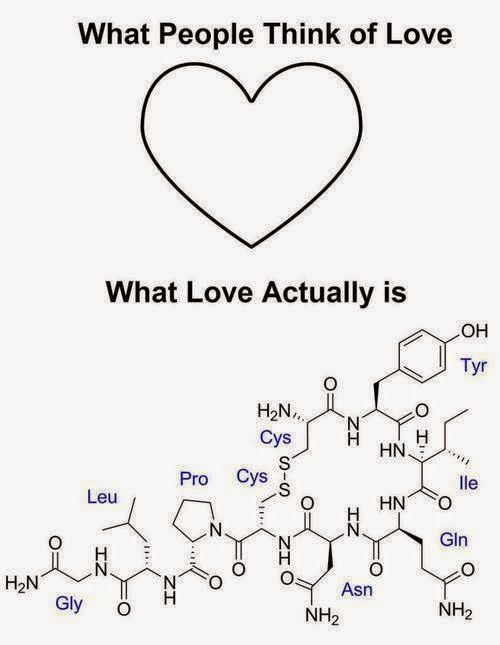
Scientists have also made great strides in elucidating the biochemical basis for love with the discovery of oxytocin, aka the “love hormone” or the “cuddle chemical”, which floods the brain during pair-bonding events, such as sex, childbirth, or eating a Reese's Peanut Butter Cup. In addition to forging pair bonds during sex, oxytocin appears to be instrumental in causing moms to love and care for their kids. Rat mothers given an agent that blocks oxytocin release disregard their newborn pups. There is even a review article on oxytocin written by a Dr. Love – no joke!

Lou Gramm of Foreigner once crooned, “I want to know what love is, I want you to show me.” Here you go, Lou.

So there you have it:  love is an evolutionary tactic that helps us propagate our genetic legacy. Let’s see Barry White work that into a song. It is not the most romantic answer, but remember…just because we know how the roller coaster works doesn’t make the ride any less thrilling.

*It should be noted that kin selection is seen in many species, and not just animals. For example, kin selection is seen in insects and even in plants!

Contributed by:  Bill Sullivan
(heart) Bill on Twitter.


Love TM (2014). Oxytocin, motivation and the role of dopamine. Pharmacology, biochemistry, and behavior, 119, 49-60 PMID: 23850525

van Leengoed E, Kerker E, & Swanson HH (1987). Inhibition of post-partum maternal behaviour in the rat by injecting an oxytocin antagonist into the cerebral ventricles. The Journal of endocrinology, 112 (2), 275-82 PMID: 3819639

Domingue, B., Fletcher, J., Conley, D., & Boardman, J. (2014). Genetic and educational assortative mating among US adults Proceedings of the National Academy of Sciences, 111 (22), 7996-8000 DOI: 10.1073/pnas.1321426111

Tuesday, July 29, 2014

Is homosexuality "natural"?

Gay marriage. Strangely, this opportunity to celebrate a loving unity has emerged as one of the most divisive issues of our time. While most people against gay marriage cite religious reasons, some have argued that homosexuality “ain’t natural”, implying that this sort of behavior does not exist in nature. We will leave it to others to debate the religious arguments, but science has made it abundantly clear that homosexuality is perfectly natural.

In the beginning, there was no sex. That’s because in the beginning, there was no Barry White. Actually, our most ancient, single-celled progenitors simply had no need for sex since they could just split right down the middle to make a daughter cell. Aside from an occasional mistake during DNA replication, asexual reproduction results in a veritable clone of the parent cell. While no fun, it is an efficient system on an individual level – so efficient that asexual organisms like bacteria continue to dominate this world in terms of abundance.

It’s only love doing its thing.
But if everyone were a literal “chip off the ol’ block”, it leaves little room for diversity to appear rapidly within the species. Sex may have evolved because it is a powerful means to diversify the species’ portfolio; the more diverse the members of a species are, the more likely that some could survive a catastrophic event, such as a viral infection that wipes out 90% of the population, or the release of The Matrix sequels, which bored countless moviegoers to death. Sex creates diversity among the species because instead of generating clones, the offspring are a blend of two genomes. Thus, there is a greater chance that the children will possess unique characteristics, some of which may have never been seen before in that population. This diversity can give sexual organisms an advantage when battling parasites or predators, an idea known as “The Red Queen Hypothesis”.


If sex is such an advantage for a species, than why is there homosexuality? Scientists do not yet know the definitive answer to this question, but some plausible ideas have been put forth. First, we are a product of our genes. Our genes largely govern the types and amounts of hormones and hormone receptors coursing through our veins. Our genes contain the blueprint to build brain structures such as the hypothalamus, which is known to control sex hormone release and behavior. Variations in these genes could conceivably alter a person’s biochemistry of attraction – they could be attracted to members of the same sex, both sexes, or have no attraction to either sex (asexual). It is also highly likely that epigenetic factors from the environment interplay with our genes to create sexual preference. Whatever the case may be, we do not get to pick our genes or our biochemistry. Just like eye color or the ability to curl one’s tongue, people have absolutely no choice in their sexual orientation.


One thing that is undeniably certain is that homosexuality is not exclusive to humans. In fact, it is EVERYWHERE. All sorts of animals across different kingdoms – from insects to primates – exhibit homosexual behavior. Let's review some examples.

As any sheepherder will tell you, as many as one in ten rams are gay.

Sorry, wrong "Rams"!

How about penguins? Yes! There was even a famous story a couple years ago about two gay penguin males in a zoo, Buddy and Pedro, who became “gay penguin parents”. Proving that two gay dads can successfully raise a family, these king penguins teamed up to incubate an egg and bonded as any heterosexual family would have done.
A children’s book based on the two penguin dads is available.
Homosexual behavior is in the air. A variety of birds, such as the Laysan Albatross, and insects, such as flour beetles, have been observed in same-sex pairings. Finally, come with me to the sea of love and you’ll find homosexual activity in bottlenose dolphins. 

As mentioned before, homosexuality is also observed in other primates such as our close cousin, the bonobo. Bonobos are so into free love that they have even been referred to as “the hippie ape”. Both males and females are bisexual and use sex as a greeting and to resolve conflict. This is also why they make “Planet of the Apes” movies and not “Planet of the Bonobos”.


Why would species do this? Isn’t the emergence of homosexuality akin to draining the gene pool since reproduction will be reduced? The answer may be all about balance. Sometimes a species proliferates faster than resources can be replenished, which could lead to extinction. Homosexuality has been postulated by the Pulitzer Prize winner sociobiologist E.O. Wilson to be a means of population control, bringing the species into biological balance with the resources in its environment. While there is evidence that homosexuality has a biologic or sociobiologic component, the degree to which these play a role is still being defined.

Contributed by:  Bill Sullivan
Van Houdenhove E, Gijs L, T'sjoen G, & Enzlin P (2014). Asexuality: A Multidimensional Approach. Journal of sex research, 1-10 PMID: 24750031

Rice WR, Friberg U, & Gavrilets S (2012). Homosexuality as a consequence of epigenetically canalized sexual development. The Quarterly review of biology, 87 (4), 343-68 PMID: 23397798