Showing posts with label Survivor. Show all posts

Thursday, February 12, 2015

Happy Valentine's Day! What Is Love, Anyway?

Many an ‘80s band has pondered the timeless question:  Howard Jones asked “What is Love”, Foreigner lamented “I Want To Know What Love Is”, and both Survivor and Whitesnake wondered “Is This Love”, just to name a few. Recently, a pair of skeletons was discovered in Leicestershire, England, holding hands for the past 700 years. Well, either that or they were thumb-wrestling enthusiasts.

"I wanna hold your hand"
It is hard for us humans to imagine a world without love, but the universe has been going about its business with complete dispassion for billions of years. The appearance of life on Earth did little to change that at first, but after a couple billion years, life forms began to emerge with brains sophisticated enough to make love possible. So it is clear that love is not requisite for life; for every animal that can experience love, there are billions of bacteria living with that animal that do just fine without it.

Many of Earth’s creatures thrive without any need for love.

Granted, bacteria divide asexually, so there is no need to wine and dine a partner who is probably not going to return your 33 calls anyway. You might think that love is needed for sex, but many life forms that have sex, including parasites, plants, insects, and frat boys, do so without love, further begging the question:  why does love exist?

At first sight, love would seem to be counterintuitive to evolution, which is often characterized as the “blind watchmaker” driven by “selfish genes” tinkering to build the fittest survival machine. However, love can confer extraordinary benefits to its practitioners, which is especially important when their offspring are unfit to survive on their own after birth. Most scientists agree that love evolved to prompt species to protect their offspring (this is known as kin selection*), and this altruistic behavior often extends to others who share similar genes. A recent study from April of this year has indeed shown that spouses tend to have similar DNA, and we reported a study a few weeks ago about friends having similar DNA. In other words, an objective analysis reveals that love is a stealthy manipulation orchestrated by selfish genes in order to trick us into protecting their legacy.

Certain dating web sites are capitalizing on the discovery that spouses share highly similar DNA. You can find your genetic soul mate by viewing the genes of potential partners as you check out what they look like in tight jeans.

Back in the 80s we didn’t have technology that could identify our genetically compatible companion, so we had to rely on the wisdom of the great philosopher Sammy Hagar to teach us how we know “When It’s Love”.


Scientists have also made great strides in elucidating the biochemical basis for love with the discovery of oxytocin, aka the “love hormone” or the “cuddle chemical”, which floods the brain during pair-bonding events, such as sex, childbirth, or eating a Reese's Peanut Butter Cup. In addition to forging pair bonds during sex, oxytocin appears to be instrumental in causing moms to love and care for their kids. Rat mothers given an agent that blocks oxytocin release disregard their newborn pups. There is even a review article on oxytocin written by a Dr. Love – no joke!
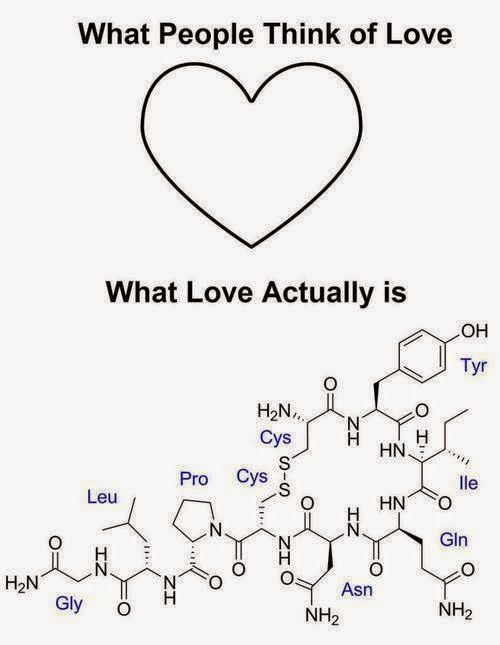
Lou Gramm of Foreigner once crooned, “I want to know what love is, I want you to show me.” Here you go, Lou.

So there you have it:  love is an evolutionary tactic that helps us propagate our genetic legacy. Let’s see Barry White work that into a song. It is not the most romantic answer, but remember…just because we know how the roller coaster works doesn’t make the ride any less thrilling.

*It should be noted that kin selection is seen in many species, and not just animals. For example, kin selection is seen in insects and even in plants!
Contributed by:  Bill Sullivan
(heart) Bill on Twitter.


Love TM (2014). Oxytocin, motivation and the role of dopamine. Pharmacology, biochemistry, and behavior, 119, 49-60 PMID: 23850525

van Leengoed E, Kerker E, & Swanson HH (1987). Inhibition of post-partum maternal behaviour in the rat by injecting an oxytocin antagonist into the cerebral ventricles. The Journal of endocrinology, 112 (2), 275-82 PMID: 3819639

Domingue, B., Fletcher, J., Conley, D., & Boardman, J. (2014). Genetic and educational assortative mating among US adults Proceedings of the National Academy of Sciences, 111 (22), 7996-8000 DOI: 10.1073/pnas.1321426111

Thursday, November 20, 2014

Science Identifies The Catchiest Songs Ever – Did Your Favorite Make The List?

Humans have a deeply rooted love for music and rhythm. For reasons we’ve yet to fully understand, certain types of music bring out the warrior inside of us while other types of music are incredibly soothing. Some songs move us to tears, yet others make us angry. And humans are not alone their capacity to respond to music. There is something about these unnaturally occurring sound patterns that speaks (sings?) to all species capable of sensing the reverberations.

Music can hold great power over us. Songs can change moods, spark memories, or inspire greatness. Some of you may have seen the video of Henry, an unresponsive gentleman in a nursing home, spring back to life after hearing his favorite music. Watch this remarkable episode below as neurologist Oliver Sacks explains the phenomenon.


We are also attuned to how divergent musical tastes can be! Teens rarely like the music that their parents listen to and vice versa. David Hasselhoff has an inexplicable legion of devoted fans in Germany. Michael Bolton somehow scored multiple hits despite piercing millions of eardrums. Some only listen to country, rap, rock, or classical, yet some people have promiscuous ears that love it all. And, let’s admit it, jazz is only fun for the musicians playing it.

Germans love the music of David Hasselhof so much that they've placed an eerily realistic wax statue of The Hoff by the Brandenburg Gate.
John Mellencamp once declared that the world is “polluted” with songs. With an estimated 2-5 billion songs having been written throughout human history, it is pretty remarkable for one to gain widespread popularity. The songs that manage to stand out from the crowd are typically called “earworms” because they are so catchy that you can’t shake them out of your head no matter how hard you try. Some of these tunes dig their talons so deeply into your subconscious that it can be agonizing; for example, here’s a list of infectious songs that were actually used to torture people.

Recently, Dr. John Ashley Burgoyne, who calls himself a computational musicologist, used an online game called “Hooked on Music” as a tool to identify some of the catchiest songs humans have ever concocted. Want to know what they are?

Coming in at number 5 is the ABBA hit, “SOS”:

The fourth catchiest song is “Just Dance” by Lady Gaga:


“Eye of the Tiger” by Survivor, the theme from Rocky III, punches in at #3:


One-hit wonder Lou Bega swings in at #2 with “Mambo No.5”:


And the catchiest song ever…(fake electronic drumroll)…“Wannabe” by the Spice Girls:


It should be noted that Burgoyne’s research relied on an internet game to generate the list of catchy songs, so there is inherent bias among the participants. Other research that employed a different algorithm (or should that be “algorhythm”?) have, perhaps thankfully, revealed different results.

All the fun aside, there is a serious element to researching why catchy songs are so easily remembered. The scientists involved with these types of studies hope that their work will reveal news insights into learning and memory, which could potentially be useful in treating conditions such as Alzheimer’s disease.
Contributed by:  Bill Sullivan
Snowdon CT, & Teie D (2010). Affective responses in tamarins elicited by species-specific music. Biology letters, 6 (1), 30-2 PMID: 19726444

Thursday, October 16, 2014

Blood. It’s What’s For Dinner.

Halloween will soon be upon us, and our streets will once again be filled with ghosts, zombies, Lady Gagas, and other terrifying creatures of the night. And you can “count” on seeing a few vampires as well, lurking through the shadows in search of blood.

Okay, so maybe not all vampires are scary. If you have trouble sleeping Halloween night, check out this movie and “howl” with laughter.
The practice of feeding on blood, known as hematophagy, is actually a lot more common than you might realize. A wide variety of creatures suck blood, including bats, ticks, leeches, vampire finches, politicians, and so on. Similar to milk, blood is an easily accessable liquid meal containing many proteins and lipids – it does a body good. Many people who are not undead also consume blood, either directly or cooked in foods like sausages, pancakes, and soups. As seen on an episode of the hit reality TV show, Survivor (Africa), the Maasai of Tanzania get their blood straight out of the tap. They cut the neck of cattle just enough to collect blood to make a milk-blood cocktail, and then allow the wound to heal for another drink in the future.  


But not all creatures can easily digest blood. Plasmodium, the single-celled parasite that causes malaria, had to evolve some clever strategies to deal with the toxic byproducts that accumulate during the breakdown of hemoglobin, the oxygen-carrying molecule that comprises approximately 96% of the red blood cells’ dry content by weight in mammals.


(a) The malaria parasite is injected into the host’s bloodstream by another bloodsucker, the mosquito. (b) Sporozoites migrate to the liver and develop into merozoites that invade red blood cells (c). (d) Gametocytes then develop in red blood cells that can be taken up by another mosquito, which will bite a new host to continue the cycle. Life cycle image from: http://www.nature.com/nature/journal/v462/n7271/full/462298a.html   

While in the red blood cell, the parasite replicates like mad. That feverish replication requires a lot of raw materials, like amino acids to build new parasite proteins. Fortunately for the parasite, those red blood cells are rich in hemoglobin, which can be broken down into amino acids the parasite can use. However, as any malarial parasite (or Dr. Dan Goldberg) will tell you, the digestion of hemoglobin is not trivial. As the parasite’s enzymes break it down, the free heme molecules that are released as by-products within the parasite’s food vacuole are highly toxic. If these heme molecules are not disposed of properly, the parasites would die in their own waste.

Bloodsucking humans have an enzyme called heme oxygenase, which can degrade toxic heme; so unlike the malaria parasite, vampires do not need to worry about heme toxicity. But they do have trouble keeping their teeth clean!

So how does Plasmodium solve this problem? If heme were lemons, hemozoin would be the lemonade. The parasite neutralizes the toxic heme subunits by sticking them together into an inert crystal structure called hemozoin. Hemozoin crystals are non-toxic and provide decorative conversation pieces to dress up the parasite’s food vacuole. Probably looks a lot like Shirley MacLaine’s house.

Hemozoin crystals formed within the food vacuole of the malarial parasite.

Incidentally, the process of building hemozoin turns out to be an Achilles’ heel for malaria, as a number of antimalarial drugs work by interfering with hemozoin formation. Unfortunately, the malarial parasite is remarkably adaptive and has evolved multiple ways to become resistant to several drugs in this family.

Contributed by:  Bill Sullivan
Follow Bill on Twitter.


Goldberg, D. (2013). Complex nature of malaria parasite hemoglobin degradation Proceedings of the National Academy of Sciences, 110 (14), 5283-5284 DOI: 10.1073/pnas.1303299110

Gorka AP, de Dios A, & Roepe PD (2013). Quinoline drug-heme interactions and implications for antimalarial cytostatic versus cytocidal activities. Journal of medicinal chemistry, 56 (13), 5231-46 PMID: 23586757

Wednesday, October 1, 2014

What Is Love, Anyway?

Many an ‘80s band has pondered the timeless question:  Howard Jones asked “What is Love”, Foreigner lamented “I Want To Know What Love Is”, and both Survivor and Whitesnake wondered “Is This Love”, just to name a few. Recently, a pair of skeletons was discovered in Leicestershire, England, holding hands for the past 700 years. Well, either that or they were thumb-wrestling enthusiasts.

"I wanna hold your hand"
It is hard for us humans to imagine a world without love, but the universe has been going about its business with complete dispassion for billions of years. The appearance of life on Earth did little to change that at first, but after a couple billion years, life forms began to emerge with brains sophisticated enough to make love possible. So it is clear that love is not requisite for life; for every animal that can experience love, there are billions of bacteria living with that animal that do just fine without it.

Many of Earth’s creatures thrive without any need for love.

Granted, bacteria divide asexually, so there is no need to wine and dine a partner who is probably not going to return your 33 calls anyway. You might think that love is needed for sex, but many life forms that have sex, including parasites, plants, insects, and frat boys, do so without love, further begging the question:  why does love exist?

At first sight, love would seem to be counterintuitive to evolution, which is often characterized as the “blind watchmaker” driven by “selfish genes” tinkering to build the fittest survival machine. However, love can confer extraordinary benefits to its practitioners, which is especially important when their offspring are unfit to survive on their own after birth. Most scientists agree that love evolved to prompt species to protect their offspring (this is known as kin selection*), and this altruistic behavior often extends to others who share similar genes. A recent study from April of this year has indeed shown that spouses tend to have similar DNA, and we reported a study a few weeks ago about friends having similar DNA. In other words, an objective analysis reveals that love is a stealthy manipulation orchestrated by selfish genes in order to trick us into protecting their legacy.

Certain dating web sites are capitalizing on the discovery that spouses share highly similar DNA. You can find your genetic soul mate by viewing the genes of potential partners as you check out what they look like in tight jeans.

Back in the 80s we didn’t have technology that could identify our genetically compatible companion, so we had to rely on the wisdom of the great philosopher Sammy Hagar to teach us how we know “When It’s Love”.


Scientists have also made great strides in elucidating the biochemical basis for love with the discovery of oxytocin, aka the “love hormone” or the “cuddle chemical”, which floods the brain during pair-bonding events, such as sex, childbirth, or eating a Reese's Peanut Butter Cup. In addition to forging pair bonds during sex, oxytocin appears to be instrumental in causing moms to love and care for their kids. Rat mothers given an agent that blocks oxytocin release disregard their newborn pups. There is even a review article on oxytocin written by a Dr. Love – no joke!

Lou Gramm of Foreigner once crooned, “I want to know what love is, I want you to show me.” Here you go, Lou.

So there you have it:  love is an evolutionary tactic that helps us propagate our genetic legacy. Let’s see Barry White work that into a song. It is not the most romantic answer, but remember…just because we know how the roller coaster works doesn’t make the ride any less thrilling.

*It should be noted that kin selection is seen in many species, and not just animals. For example, kin selection is seen in insects and even in plants!

Contributed by:  Bill Sullivan
(heart) Bill on Twitter.


Love TM (2014). Oxytocin, motivation and the role of dopamine. Pharmacology, biochemistry, and behavior, 119, 49-60 PMID: 23850525

van Leengoed E, Kerker E, & Swanson HH (1987). Inhibition of post-partum maternal behaviour in the rat by injecting an oxytocin antagonist into the cerebral ventricles. The Journal of endocrinology, 112 (2), 275-82 PMID: 3819639

Domingue, B., Fletcher, J., Conley, D., & Boardman, J. (2014). Genetic and educational assortative mating among US adults Proceedings of the National Academy of Sciences, 111 (22), 7996-8000 DOI: 10.1073/pnas.1321426111

Friday, August 15, 2014

The Friday Five

Highlighting some of the coolest science news we’ve seen lately.

1. Ever wonder if a blood-sucking insect gets drunk after sucking an intoxicated person’s blood?


2. You can't hurry love...but scientists have calculated how many soul mates you have in the world. Find out how they did this and how many are waiting for you. Go get 'em, tiger, then play them this song!


3. First, scientists made the "nude" mouse, and now they made one that is see through! Scientists have also recently created the invisible mouse, but no one can seem to find it (ba dum dum).


4. Scientists have reported that the memory of starvation can be inherited through the passage of small RNAs to offspring...for at least three generations (in worms, at least). You're not only what you eat, but you're what your great great grandparents ate!

5. It's not all in your head...music can make you feel powerful – especially pumping up the bass! Rock on, tiger.


Bonus!
Last month we wrote about the sequencing of Ozzy Osbourne’s genome. Here is a great video explaining how the human genome is sequenced.


Science quote of the week:
“All of science is nothing more than the refinement of everyday thinking.” –Albert Einstein

Contributed by:  Bill Sullivan

Follow Bill on Twitter: @wjsullivan


Rechavi, O., Houri-Ze’evi, L., Anava, S., Goh, W., Kerk, S., Hannon, G., & Hobert, O. (2014). Starvation-Induced Transgenerational Inheritance of Small RNAs in C. elegans Cell, 158 (2), 277-287 DOI: 10.1016/j.cell.2014.06.020

Yang B, Treweek JB, Kulkarni RP, Deverman BE, Chen CK, Lubeck E, Shah S, Cai L, & Gradinaru V (2014). Single-Cell Phenotyping within Transparent Intact Tissue through Whole-Body Clearing. Cell PMID: 25088144

Hsu, D., Huang, L., Nordgren, L., Rucker, D., & Galinsky, A. (2014). The Music of Power: Perceptual and Behavioral Consequences of Powerful Music Social Psychological and Personality Science DOI: 10.1177/1948550614542345