Showing posts with label national electrical grid. Show all posts

Tuesday, January 20, 2015

The Electrical Grid Needs Fattening Up


Heimlich was the caterpillar from one of my kids’
favorite movies, A Bug’s Life. He ate and ate because
he needed to store energy. When the time came to
metamorphose into a butterfly, he would need to
convert that stored energy to forms his body could
use. We need the same thing for our national
energy grid.
When presented with food, you can convert it all to energy (stuff your face), or can save some for later (leftovers). We can make use of much food over time and not lose any of its energy, most of the food won't spoil before tomorrow or the next day. Likewise, your body can store energy it takes in, some as glycogen, and some as fat. We can go back later to burn the fat when we need extra energy – although we usually don’t.

This isn’t the case with the national energy grid. Whatever energy is generated, it goes directly into the copper wires of the transmission network. This is fine most of the time, because you can run more or fewer generators, and they can be made to work at higher or lower efficiency to meet immediate needs.

The real problem comes when we try to be green. Some fuel for generators can be used when needed, but other sources of energy have to be used when they are available. For example, it doesn’t matter whether you burn coal today or ten years from now, you still get the energy from it.

But think about wind power. If you don’t generate electricity from the wind as it blows, then you can’t go back later and use it – it’s gone with the wind. Same with solar energy, if you don’t harvest today’s sunshine, you can’t come back tomorrow and find it. Sure, you can use tomorrow’s sunshine, as long as it’s sunny – but not everyday is sunny.

As more and more electricity is generated from green sources, we need to harvest as much of it as we can when we can. This means that we need to be able to store energy in some form. This large-scale energy storage is the focus of much current research and even more construction.

If we can’t store electricity as electricity, it means we have to convert (transduce) it to some form of potential energy. Research and engineering is showing that we can do this in several ways. Let’s look at a few:

Compressed air storage – One source of potential energy is air under pressure. Of course, it would have to be a whole bunch of air, like an abandoned mine volume of air - or one speech from a politician. Several of these large-scale energy storage mechanisms have been set up in Europe, using mines or caverns.


Here is a schematic for compressed air storage of
energy. The compressor motor uses energy from the
grid to pump air into a huge space – maybe somewhere
that has given up its natural gas. Then when it escapes,
it runs turbines that return electricity to the grid. I bet
fracking opponents might have a problem with this as
well – geologically speaking.
Some caverns are better than others. Salt caverns (McIntosh, Alabama) are good because the crystal is flexible without being porous; no reaction occurs between the walls and the oxygen. When there's less demand on the grid, air compressors use the extra electricity to pump air into a sealed mine. Newer proposals seek to use pipelines to store the compressed air.

Under pressure, the air can remain as a source potential energy for an undetermined time. When the grid needs more electricity, the pressurized air is allowed to escape, passing across turbine blades and turning a generator. Basically, it’s electricity to wind to electricity.

Compressed air storage is about 45% efficient. If you use the heat created by compressing the air (pushing the molecules together creates friction and heat) to heat the air when it expands (usually it cools greatly, like when you spray off your computer keyboard with that can of air and the long red straw), you can increase the efficiency to about 70%. That ain’t bad.

Hydrogen – Hydrogen gas is a very dense fuel source, meaning that you get a lot of energy for the amount of fuel you use. However, you first have to produce the hydrogen. One way is to split water, just like plants do during photosynthesis. While plants use the power of the sun to split water, we can use electricity – this is called power to gas generation. Gas generated is usually hydrogen from water, but methane can also be produced from carbon dioxide plus water.

The hydrogen gas produced is then stored, similar to the compressed air storage described above. For more efficiency in storage, the hydrogen can be cooled and pressurized to be stored as a liquid. When electricity needs to be generated, the gas can be burned to heat water for conventional turbine generators, or it could be put through large fuel cells, as we discussed two weeks ago.

Caverns and mines can be utilized for storage, but Germany uses mostly hydrogen pipelines for storage, and has done so for many years. In fact, German hydrogen storage is some 5000x greater then their pumped water storage capability. I’d worry about explosions. Remember the Hindenburg - that was hydrogen gas.


This is how pumped water storage works. They
picture shows the direction for daytime and nighttime,
but it could be anytime energy is excess or needed. The
reason for day and night labels is that you can make it
in the day when more is needed and store it at night,
when energy usage is lower. In addition, using electricity
at night is cheaper (less demand = less cost).
Pumped Water - A new pumped water storage facility is near the approval stage in Montana. The Gordon Butte project will build a pair of 1.3 billion gallon (6.4 billion liter) reservoirs, one atop the butte and one 1025 ft (312 m) below, at the bottom of the butte. The U.S. and China have many of these facilities, the largest of which is located on the Virginia, West Virginia border (Bath County, 3 GW).

When there is excess energy in the grid, it will automatically be used to power pumps that will move water from the lower reservoir to the upper. This mass of water, positioned in the top reservoir is a powerful source of potential energy.

During peak usage hours, the water is allowed to fall to the lower reservoir, through a turbine that then powers a generator. At this point, the system acts exactly like a typical hydroelectric plant. These mechanisms are very efficient, returning 75-85% of the energy invested in them. The problems: you need sufficient space at two nearby locations, but at very different elevations, and two, reservoirs are very expensive to dig. I wonder if drought would be a problem.

The real advantage to pumped water storage over other large-scale storage methods is the timing. Pumping or generating can begin within just 5-7 minutes of declared need, while compressed air storage facilities take more than 30 minutes to ramp up.


Electric vehicles will need be chargeable wherever they
are if we are to make them a source of energy storage
for the grid. Here is the new thing – wireless rechargers.
The top image shows them implanted in parking spots,
while the lower images has them embedded in the
parking blocks. Yes those concrete obstructions in
parking lots are called parking stops or parking
blocks – bet you didn’t know that.
Electric Cars – One intriguing idea is to use privately and publicly owned electric vehicles as a storage dump for energy. The batteries of such cars can be connected to the grid in a two-way fashion. You plug them in at night to recharge the battery, but a V2H (vehicle to home) system also allows you to draw energy from the car battery in case your house power lines are down.

A study from 2011 used mathematics (eww!) to estimate the viability of electric vehicles as a large scale energy storage mechanism. In general, two things will have to happen. One, 10 million or more people (in U.S.) need to own these cars. And two, they have to be able to plug in their cars at work. Only with work and home charging will enough cars be plugged in at any one time so that a grid need will be met, either by pumping more energy into the car batteries or taking a bit of energy from each car.

There are several other methods – large, rechargeable batteries are starting to be used. Painesville, OH has a 1 MW vanadium battery in use, as well as large flywheels, or thermal storage. You can investigate these yourself and figure out how best to make green energy pay off in the long run..


Contributed by Mark E. Lasbury, MS, MSEd, PhD


F. K. Tuffner, Member, IEEE, and M. Kintner-Meyer, Member, IEEE (2011). Using Electric Vehicles to Mitigate Imbalance Requirements Associated with an Increased Penetration of Wind Generation Power and Energy Society General Meeting, 2011 IEEE , 1-8


Tuesday, January 13, 2015

Delicate Arteries Of Energy


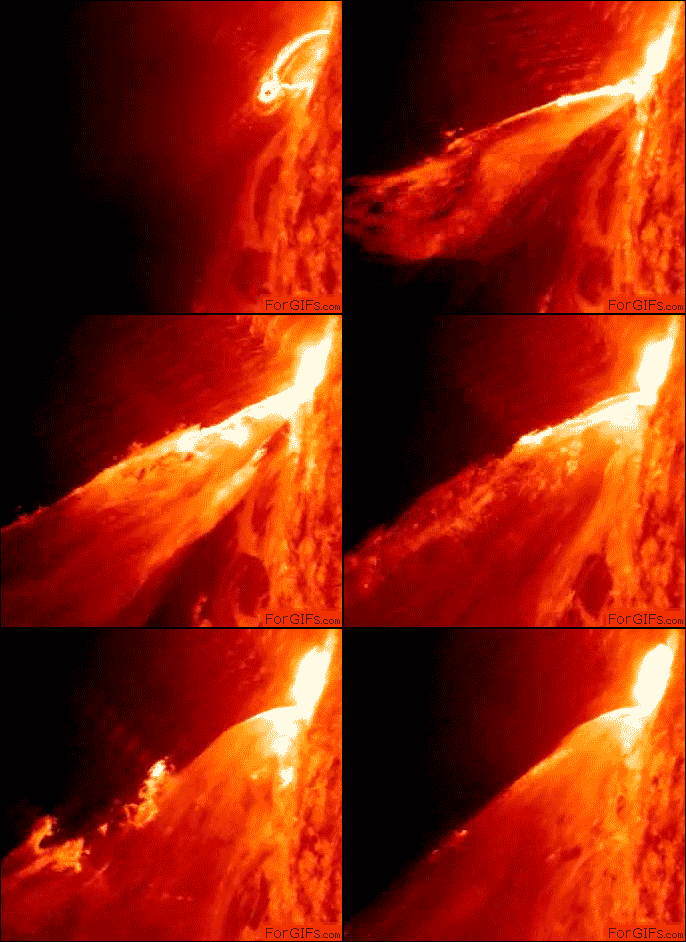
Solar flares could take out the electrical grid – and have.
A moderate flare in 1989 caused a power outage in
Canada for millions of people for over nine hours.
Studies show that a solar electromagnetic pulse (EMP)
from a flare is much more likely to occur than
an intentional EMP attack. How big was the flare in the
image above? It was about 100,000 km (62,000 miles) long.
Every once in while I have a morning where bad luck just seems to follow bad luck. One thing leads to another, every turn brings a new and bigger disaster. This is called a cascading failure, and is a real possibility for the American electrical system. A 2013 study stated that cascading failure of the grid isn't just possible, it's inevitable; it's just a matter of when.

It occurs to me that the subject of today’s post – the national power grid - is a delicate artery of modern society. Considering our reliance on electricity, a energy hemorrhage caused by a severe weather event, a breakdown in infrastructure, a solar event of just medium size, or just a few cleverly placed acts of terror could bring us to our knees. Do you know why? Do you know how electricity comes to your house?  Let’s look at the national grid and see why it's vulnerable.

We stated last week that the majority electricity is produced by generators attached to turbines – the turbines being spun by steam or water. In 2012, there were more than 19,000 generators operating at 7000 power plants in the United States (those producing 1 megawatt or more). That’s one power plant for every 45,000 people in the U.S, or one for every 550 square miles in the continental U.S., on average.

You can see that the loss of one generating station could have an effect on the distribution of power, and a few going down at the same time could cause a significant problem. Luckily, there are backup generators that can be brought on line in case of problems or if more power is needed, but the point is still made.


Turbine blades spin a shaft. The shaft is attached to
a magnet that then also spins. It passes by coils of
wire; this generates electricity.
Electricity is made from each generator, but to be more efficient, the spinning magnet passes by three wire coils instead of one, so that three lines of electricity are produced from one generator (see animation). This is referred to as three phase power generation, and its presence can be noted in the electrical lines you see every day.

When alternating current is generated it switches from one direction to the other and back, reaching maximums on either side of a middle line. If you graph it out, it looks like a sine wave (see picture below). Energy is lowest when it is near the zero line, either going down or coming back up. By having three lines of electricity generated, each 120 degrees out of phase, there is almost always a line near a maximum value. This makes for efficient power generation. Four lines isn't much more efficient than three, but three is much more efficient than two – draw it out and see.


Each coil set in a generator produces a current that
is 120 degrees out of phase with the others, in total
it produces a much more even current for high
demand uses.
For high energy requiring equipment, like in industrial settings, three lines are needed to provide enough energy. Having three lines out of phase provides a near even power output, one line is almost always at a maxima. This is the biggest advantage of three phase generation.

The three lines of electricity produced by the generators are inserted into the national electric grid. This is the interconnected network of lines and stations that move electricity from the generating stations to the consumers. Every electrical line you see, from the one entering your house, to the high tension lines that tower over the farm fields, is part of the electrical grid. There are also the lines you can’t see because they are buried – so the grid is even bigger than you think.

When electricity leaves the generating station it is stepped up to a much higher voltage (155,000 to 765,000 volts) so that it can be transferred long distances along the transmission network in a smaller number of wires and with lower energy loss. These high-tension lines travel to the local power company that will distribute it to customers via a local distribution network that it owns.


The high tension line on the left carries two sets of four
three phase systems (1 and 2). The four lines in each
group (1a, etc) are of the same phase. Nearer your house,
the lines look more like what is on the right. The three
phase lines are on top, much of the other stuff is for TV,
telephone, or for distribution of the electricity to houses.
Look at the high-tension lines in the picture to the left or those near you. You will always be able to pick out a series of three lines, along with ground wires that protect the grid from lightning strikes and the like. Those three lines are the three phase power lines, one for each line of electricity.

At power substations, the voltage is stepped back down (around 10,000 volts), but not down to the level at which it will enter your house. From here, the electricity is passed through a bus that splits it to many directions, and through the distribution network. In many bus splits, there will be higher voltage and lower voltage lines, depending on the distance and customer need.

The three lines (still three phase power) move out into the neighborhoods, and get stepped down to the customer usage level, 240 amps. There are buses on the line that split electricity off to each house, this is the first time that they don’t travel in their group of three. The single line enters your house via your electrical meter which records the amount of electricity that is delivered over time in kilowatt hours.


We are moving toward smart grids. They are smaller than
a national grid, use different source of generating power,
and can move in two directions, so customers can generate
power and contribute to the grid.
From here, all you need to have is a satisfactory wiring plan for you house and you can plug in your charging cord and juice up your phone, or plug your blender into an outlet and make some margaritas.That is, until the grid goes down and you have a blackout.

The grid has some built in protections against black outs, mostly through redundancy. Any part of the entire grid can’t really be described as grid-like unless it is redundant. Power must come from more than one source, so that electricity can be subverted to areas of higher need, and so that a loss of some part of the grid can be compensated for by other sources. Notice that when a tree falls across a line, it is a specific area that goes black. This represents the part of the distribution that is not redundant.

If that were to occur in the transmission or distribution networks (although it would have to be an awfully tall tree), then the redundancy would pull power from another source and through other grid lines. The vulnerability lies in taking out several high tension lines that are the redundancy for a large area, or more likely, in taking out the high voltage transformers.


This is a main power step up transformer, the type that is
vulnerable to terrorist attack. This one doesn’t have lines
connected to it since it is under construction. You can see
how it would be costly and time consuming to replace.
A report by the Congressional Research Service in mid-2014 stated that the high voltage, step up transformers are a likely target for terrorists because they serve large areas, are expensive and hard to replace, and because hitting only a few could cripple a large population. In addition, the transmission lines are just out there in the open. There's no way that they can be protected from terrorist attacks. See now why the grid is so vulnerable?

You notice that there are no dumping grounds for excess energy produced here. The electricity made goes directly into the lines. Copper wires can’t hold electricity, they just transmit it. But what happens if you make too much - is it wasted? Next time we will look at the burgeoning field of large-scale energy storage.


Contributed by Mark E. Lasbury, MS, MSEd, PhD
As Many Exceptions As Rules


Paul W. Parfomak (2014). Physical Security of the U.S. Power Grid: High-Voltage Transformer Substations Congressional Research Service Reports
 
Bashan, A., Berezin, Y., Buldyrev, S., & Havlin, S. (2013). The extreme vulnerability of interdependent spatially embedded networks Nature Physics, 9 (10), 667-672 DOI: 10.1038/nphys2727