Showing posts with label Harry Potter. Show all posts

Tuesday, February 24, 2015

Seeing Our Way to Invisibility


The Federation did not use cloaking devices, and
the Treaty of Algernon prevented them from
developing them. However, sometimes you have to
use what you have, so Enterprise did make use of a
stolen cloaking device to escape some Romulans in
The Next Generation series.
Gene Roddenberry believed in the idea of heroes and fair play. That’s why the Federation didn’t have cloaking devices. He stated in several interviews that, “heroes don’t sneak around.”


That’s why the Romulans and the Klingons had cloaking devices for their ships, but the Federation didn’t (with very rare exceptions). It's one of the few toys that came from the series that wasn’t a Federation invention or used by them. But it was awfully cool.

You hit a button and your ship disappears for everyone looking at it. The idea wasn’t original to Star Trek, J.R.R. Tolkein had it in the Lord Of The Rings, and it was a part of many folktales hundreds of years before he gave it to Frodo. Harry Potter’s cloak is probably a direct result of Frodo’s, although the movie Predator gave it a more scientific, not magical, feel that is more reminiscent of Star Trek.

The cloaking devices in the early Star Trek episodes were not perfect, you couldn’t fire weapons while cloaked and some tracking sensors could still find you. These are some of the same problems we're having with cloaking devices today.

Oh yes, we have cloaking devices.

The Klingon bird-of-prey projected it’s invisibility through its deflector shields; we don’t have anything that cool yet, but we can make things disappear under the right conditions. However, making a ship disappear to all wavelengths of electromagnetic radiation using something projected from the ship itself is beyond us as of yet. Let’s see what we can do.


The electromagnetic spectrum is all around us, we
see with only a very small part of it. The longer the
wavelength, the lower the energy, so gamma rays are
very powerful, and radio waves can’t hurt you unless
we’re talking about your ears.
First of all, how do we sense things that are in front of us, or even a little to the side of us? Our eyes use visible light, just a small portion of the entire electromagnetic spectrum. Visible light waves from the sun or some other source strike the object; some are absorbed and some bounce off. A few of the bounced rays make it to our retina. They are the ones we decode into a shape. The object might absorb all light but red, so only the red waves bounce off and make it to our eye. We see the object as red.

But there are so many more types of waves than just visible light. Infrared waves are longer and lower energy than visible light. Heat sources give off infrared waves, so this is how you can find people in the dark with night vision goggles. Radio waves are even lower energy, while microwaves for radar are in between infrared and radio.

Higher energy waves are on the other side of the visible spectrum; things like ultraviolet, X-rays, and Hulk-producing gamma rays. All the different types of waveforms can be detected by some kind of detector or another. They all give clues to the fact that something is out there. Star Trek cloaking devices masked all of them eventually, but we’ve only gotten to the point of hiding from a few wavelengths at a time.

As with most scientific or technological advances, first we have many of ways to try it, and we finally settle on what works best. Remember VHS vs. Betamax? As our knowledge increases, we will hone in on one or two ways to make these cloaks work, but for now, there’s a bunch.

This is not to say that we haven’t been hiding things in plain sight for a long time. Camouflage is an ancient practice, something we stole from nature. Active camouflage is a little more tech-y and recent. This technique allows the camouflage to change as the background changes.
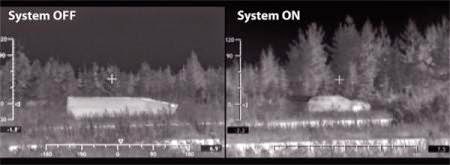

The Adaptiv technology uses hexagonal panels on the
sides and turret of tanks to project an incorrect heat
signature. To an infrared scope, they can look like a
station wagon or truck.  This is one type of active
camouflage.
One type of active camouflage is a way to project the background onto a screen or cover over the object. They have even gone so far as to make cloaks that capture background on tiny cameras in the back and project that image from pixels on the opposite side.

However, when the object moves, there is a blur as the cameras catches up to the new background. Plus, like with your TV, it only works very well when you are directly in front of it. Nobody wants to be the guy watching the Super Bowl from the uncomfortable chair that’s at a 45˚ angle to the TV screen.

There is also holographic camouflage, so that as you move past the object, the background appears to move with you. Better, but still not great. And these examples are for just visible light; nothing about a hologram projected on a sheet is going to hide your heat signal from a guy with infrared night specs. The new Adaptiv system allows tanks to project a different heat signature than they normally would (see picture above).


A metamaterial is any solid that derives its properties
from its structure, not its composition. It is how they are
made in 3-D, together with what they are made of, that
allows them to cancel out waves or bend them. On the
right is a significant feature of some metamaterials, a
negative refractive index. Regular materials can reflect
a beam more than 90˚ to the face of the object,
metamaterials can, and this is how they can bend the light
around objects.
Now we have moved on to true cloaking, which is more passive than active camouflage. The methods with which we are currently hiding objects are mostly defined by which wavelengths of radiation we want to hide them from. The first real cloak of invisibility was demonstrated in 2006, and hid a small object or part of an object from some microwave wavelengths. Other cloaks hide things only from radio waves.

Many of the newer techniques bend light around the object, sort of like a stone in a stream. The water comes back together on the other side and moves on as if the object weren’t there. Same with light rays that bounce off the background. Using proper technology, they can be made to travel around the object being cloaked and travel to your eye as if it wasn’t even there.


The mantle cloak technique uses a very thin layer of
metamaterial to bend light rays or cancel them out. Harry
Potter might have been hidden better, but I like our chances
with science better than magi
True cloaking makes use of either traditional or some complex surfaces called metamaterials (or superlenses made of metamaterials). See the picture above to learn a little about metamaterials but I suggest that quite a bit of reading is necessary to make you feel like you understand them at all. I’m not to that point yet.

The metamaterials offer several different ways to hide something, like plasmonic cloaking, where the light scattered by an object is detected by the cloak. The clock then emits a canceling wave at precisely the same length but 180˚ out of phase. The two waves cancel each other out and it is as if no light was bounced toward your eye or your detector. Other metamaterials don’t cancel the signal, but truly bend it around the object as described above.

A mantle cloak is thinner, using a metamaterial screen just a few millimeters thick to produce the antiphase radiation that cancels out whatever strikes it. This was demonstrated in 2013 by Andrea Alu from the University of Texas, just as the plasmonic cloak was a few years previous. The advantage is that the thinner the cloak or mantle, the broader the range of wavelengths that it could cancel out.


The Rochester cloak uses the mirrors of different focus
lengths to bend visible light rays. Check out this website to
make one yourself. While cloaks in the visible range are the
biggest show, the military or security will be interested in
cloaks of broad wavelengths, not just visible light.
Several groups have demonstrated the use of a  traditional lens, sometimes called a Rochester Cloak because they were developed at the University of Rochester in New York. All you need is two sets of lenses with two different focal lengths (a and b); use "a" then "b" to bend the light around, then "b" and "a" to bend it back. This isn’t really dynamic cloaking because it's stationary. Whatever is behind that lens at that moment will disappear. We need to be able to have either huge sets of lenses or make the air act like a lens so that something large and moving could be cloaked.

A big problem that we must overcome to mimic Star Trek cloaking is that fictional ships can scan and see what is out there via emission of their own probes or detectors, we can't do that yet. With current technologies, the object is covered or masked, so it can’t emit anything or see anything around it. Most current cloaks work by absorbing or channeling EM waves, so if the cloaked object emits anything, it can be detected.

As Frodo could see through the weave of his cloak, we need to be able to look out from a cloaked object and see what we want, or even send out some energy to detect things that might be out there. There is limited advantage to a cloaked ship that is ostensibly blind itself. However, 2012 experiments did develop a plasmonic cloak that detected light, so over a very narrow range it was an invisible device that could see.


Another low-tech cloak is using mirrors, but again, you
have to be positioned exactly right for them to give you
the right image. Plus, this is just for visible light, a true Star
Trek cloak would mask all wavelengths of
electromagnetic radiation.
Another problem with cloaked materials was described in a 2013 paper. Despite being “invisible” to some EM wavelengths, the cloaks may increase the scatter in the other wavelengths by the cloaked object so that the total scatter is greater than that of the uncloaked object alone.

In addition, the cloaks themselves usually scatter light, so even though the object being cloaked is hidden, the cloak itself might be detected! The authors suggest that there could be a passive solution using superconductors, or that mixed metamaterials could scatter the waves bouncing off the object to be hidden and the cloak.

Next week, how about looking at our versions of phasers – we do have them, just not small enough to be hand held.


Contributed by Mark E. Lasbury, MS, MSEd, PhD
As Many Exceptions As Rules


Choi, J., & Howell, J. (2014). Paraxial ray optics cloaking Optics Express, 22 (24) DOI: 10.1364/OE.22.029465
 
Fan, P., Chettiar, U., Cao, L., Afshinmanesh, F., Engheta, N., & Brongersma, M. (2012). An invisible metal–semiconductor photodetector Nature Photonics, 6 (6), 380-385 DOI: 10.1038/nphoton.2012.108
 
Soric, J., Chen, P., Kerkhoff, A., Rainwater, D., Melin, K., & Alù, A. (2013). Demonstration of an ultralow profile cloak for scattering suppression of a finite-length rod in free space New Journal of Physics, 15 (3) DOI: 10.1088/1367-2630/15/3/033037

Wednesday, August 20, 2014

I hate you Charley, and the horse you rode in on

Sunday is the one chance I get to wake without an alarm, but the sweet dream of sleeping in often alludes me. Sunday at 4:00 am is when bombastic thunderstorms like to roll over my house.  Or one of the kids has the worst nightmare ever. Or some bird decides to whistle the most obnoxious symphony right outside my window. But even if I manage to dodge all these premature wake up calls, a Charley Horse rides into town looking for a fight.

We’ve all experienced this neuromuscular hell at one time or another. Mine come totally unprovoked. I’m just sleeping for crying out loud, and then I’m crying out loud - wide awake and trying to twist my leg off in order to stop the excruciating pain.


A Charley Horse basically feels like someone has twisted the muscles in your leg in the opposite direction of how they are supposed to run. The sensation is due to a spasm in those muscles, which usually subsides fairly quickly, although it feels like you could watch all the Harry Potter movies before the pain ends.

“Quick, Hermione, what is the spell that cures a Charley Horse?”

Known in some circles as “nocturnal leg cramps”, and in other circles as “just amputate my @&*$# leg!”, the Charley Horse is poorly understood. We don’t even know why we call it a Charley Horse. The reference first appears in the 1880s, believed to have its origins in baseball. According to this article, “the earliest known use of the term is from the Boston Globe, 17 July 1886:  Several years ago, says the Chicago Tribune, Joe Quest, now of the Athletics, gave the name of “Charley horse” to a peculiar contraction and hardening of the muscles and tendons of the thigh, to which baseball players are especially liable from the sudden starting and stopping in chasing balls, as well as the frequent slides in base running.”

But who is this Charley? Some say it was a ball player who owned a lame horse, but others say it was an actual lame horse, possibly the one that pulled the roller at the White Sox ballpark in Chicago at the time. But in 1907, according to World Wide Words, the American Dialect Society claimed that the phrase referred to the pitcher Charley Radbourne, nicknamed Old Hoss, who suffered leg cramps during a ball game. So it is possible that the original reference did not involve horses at all. 

“Charley Hoss, Charley Horse. Pretty close, especially in Boston.”
Obviously, people were getting these involuntary leg cramps long before we decided to hitch them to a Charley or a horse. The leading school of thought is that the muscles get all bent out of shape because of dehydration or an electrolyte imbalance. But before you go swimming in Gatorade, let’s review what a muscle is and why the minerals sodium, potassium, and calcium are important to function.


So a Charley Horse is basically a locked muscle contraction. For some reason, the muscles are “high strung” and won’t relax as quickly as they should. If you need another argument against intelligent design, the Charley Horse has legs.

Some have speculated that these satanic cramps can be prevented with dietary supplements. Magnesium is commonly touted as a solution to prevent Charley Horses but don’t giddy-up to your local GNC just yet. A Cochrane study performed in 2012 concluded that, “It is unlikely that magnesium supplementation provides clinically meaningful cramp prophylaxis to older adults experiencing skeletal muscle cramps.”
"They’ll put a cramp in your wallet and you’ll still get cramps in your legs."

How about stretching your legs before bed? While stretching doesn’t do any harm, it unfortunately is not likely to keep Charley Horses in the stable. There has also been a Cochrane analysis for the use of quinine to treat muscle cramps. While quinine does show modest benefit, the risks of serious side effects do not outweigh the possible benefit.

Your doctor is likely to tell you to stay hydrated. However, the idea that dehydration is linked to leg cramps simply doesn’t hold water when researchers put it to the test. Interestingly, what does provide relief is…pickle juice! Yes, just say it three times fast and the cramps will go away…no, wait, that’s Beetlejuice.

Testing this old home remedy, scientists artificially induced muscle cramping with electricity and then administered pickle juice or water. The pickle juice, but not the water, resolved the cramps faster. But since the cramp subsided faster than electrolytes from the pickle juice could possibly be replenished, the mechanism behind the pickle juice remains unknown. The authors of the study speculate, “Something in the acidic juice, perhaps even a specific molecule of some kind, may be lighting up specialized nervous-system receptors in the throat or stomach…which, in turn, send out nerve signals that somehow disrupt the reflex melee in the muscles.”


I guess for now, the Charley Horse will remain a physiological mystery. I’m sure I’ll have time to contemplate it next Sunday at 5:00 in the morning.

Contributed by:  Bill Sullivan
Follow Bill on Twitter @wjsullivan


Garrison SR, Allan GM, Sekhon RK, Musini VM, & Khan KM (2012). Magnesium for skeletal muscle cramps. The Cochrane database of systematic reviews, 9 PMID: 22972143

Coppin RJ, Wicke DM, & Little PS (2005). Managing nocturnal leg cramps--calf-stretching exercises and cessation of quinine treatment: a factorial randomised controlled trial. The British journal of general practice : the journal of the Royal College of General Practitioners, 55 (512), 186-91 PMID: 15808033

El-Tawil S, Al Musa T, Valli H, Lunn MP, El-Tawil T, & Weber M (2010). Quinine for muscle cramps. The Cochrane database of systematic reviews (12) PMID: 21154358

Miller KC, Mack GW, Knight KL, Hopkins JT, Draper DO, Fields PJ, & Hunter I (2010). Three percent hypohydration does not affect threshold frequency of electrically induced cramps. Medicine and science in sports and exercise, 42 (11), 2056-63 PMID: 20351595