Showing posts with label evolutionary psychology. Show all posts

Tuesday, November 24, 2015

Gobble Up Some Facts About Turkeys

Just in time to impress your family at dinner (or to divert them from the annual inquisition), here are some juicy turkey facts to have on hand...

1. The Jurassic Park centerpiece at your Thanksgiving table.

See it now?
Like other birds, turkeys are descendants of dinosaurs. The dinosaur on your Thanksgiving table is about 150 million years in the making, branching off from their close relatives, the pheasant, about 11 million years ago. So even if you’re served a dry bird this year, it may become more palatable when you remember that it is a saurischian dinosaur, related to Tyrannosaurus and Velociraptor.

Ben Franklin was a big admirer of the turkey. In fact, he favored the turkey over the bald eagle to be the US National Bird. He is quoted as saying, "For in truth, the turkey is in comparison a much more respectable bird, and withal a true original native of America" - more on that below...

2. Taming the turkey:  how the turkey was won.

Wild turkeys (Meleagris gallopavo) are indigenous to wilderness regions of North America and grew to larger sizes after migrating to Central America where there were fewer predators. About 800 BC, Olmec farmers in this region were the first people believed to have used the turkey on a wide scale, harnessing the meat and eggs for food and the feathers and bones for tools and decoration. By the time of the Aztecs, who called the bird “huehxolotl”, the turkey was domesticated.

The larger size of domesticated turkeys has severely compromised their ability to run fast and fly like their wild turkey counterparts, which is another benefit for the farmer since a turkey’s eyes are on the sides of its head. This ocular arrangement coupled with a flexible neck gives the turkey a 360-degree field of vision, good enough to spot a suspicious axe-wielding farmer lurking nearby.


3. What does a turkey have in common with a peacock?

Male turkeys puff their feathers, strut and gobble loudly, and fan out their tail like a peacock in an effort to win over a female companion, who will produce up to 18 eggs per mate. The courtship rituals for both turkeys and peacocks are risky, as these flamboyant displays may draw the attention of predators (and TMZ). But this is how the ladies select their men – they don’t have the benefit of DNA-based matchmaker sites to find suitable mates. According to evolutionary psychologists, many species rely upon courtship signals as a metric for strength and intelligence. If the male can produce such a display and get away with it, he must be strong and smart enough to outwit predators – those are genes that you would want in your pool.

Turkeys evolved to blend into the wilderness. Males, however, stand out when they fan their tail, gobble, and dance. Male turkeys do this to attract females, who have tails that are comparatively boring and speak with gentle clucks rather than obnoxious gobbles.
4. The name “turkey” is based on a mistake.


English settlers arriving on the East Coast of North America around 1500 mistook the turkey (right) to be Guinea fowl (left), a bird that the English imported from Turkey at the time (incidentally, Turkish merchants acquired the fowl from West Africa). However, as indicated above, this is wrong – turkeys are not from Turkey. Despite the error, the name has stuck and shows no sign of ever being changed - "pass the huehxolotl and gravy" just doesn’t have a nice ring to it.


5. Does eating turkey make you sleepy?

Some people have claimed that the tryptophan in turkey meat makes us feel sleepy after Thanksgiving dinner. You can get the scoop on tryptophan in a previous post found here. 


Contributed by:  Bill Sullivan, Ph.D.


Russo, E., Scicchitano, F., Citraro, R., Aiello, R., Camastra, C., Mainardi, P., Chimirri, S., Perucca, E., Donato, G., & De Sarro, G. (2012). Protective activity of α-lactoalbumin (ALAC), a whey protein rich in tryptophan, in rodent models of epileptogenesis Neuroscience, 226, 282-288 DOI: 10.1016/j.neuroscience.2012.09.021

Bruce KR, Steiger H, Young SN, Kin NM, Israël M, & Lévesque M (2009). Impact of acute tryptophan depletion on mood and eating-related urges in bulimic and nonbulimic women. Journal of psychiatry & neuroscience : JPN, 34 (5), 376-82 PMID: 19721848

Wednesday, October 1, 2014

What Is Love, Anyway?

Many an ‘80s band has pondered the timeless question:  Howard Jones asked “What is Love”, Foreigner lamented “I Want To Know What Love Is”, and both Survivor and Whitesnake wondered “Is This Love”, just to name a few. Recently, a pair of skeletons was discovered in Leicestershire, England, holding hands for the past 700 years. Well, either that or they were thumb-wrestling enthusiasts.

"I wanna hold your hand"
It is hard for us humans to imagine a world without love, but the universe has been going about its business with complete dispassion for billions of years. The appearance of life on Earth did little to change that at first, but after a couple billion years, life forms began to emerge with brains sophisticated enough to make love possible. So it is clear that love is not requisite for life; for every animal that can experience love, there are billions of bacteria living with that animal that do just fine without it.

Many of Earth’s creatures thrive without any need for love.

Granted, bacteria divide asexually, so there is no need to wine and dine a partner who is probably not going to return your 33 calls anyway. You might think that love is needed for sex, but many life forms that have sex, including parasites, plants, insects, and frat boys, do so without love, further begging the question:  why does love exist?

At first sight, love would seem to be counterintuitive to evolution, which is often characterized as the “blind watchmaker” driven by “selfish genes” tinkering to build the fittest survival machine. However, love can confer extraordinary benefits to its practitioners, which is especially important when their offspring are unfit to survive on their own after birth. Most scientists agree that love evolved to prompt species to protect their offspring (this is known as kin selection*), and this altruistic behavior often extends to others who share similar genes. A recent study from April of this year has indeed shown that spouses tend to have similar DNA, and we reported a study a few weeks ago about friends having similar DNA. In other words, an objective analysis reveals that love is a stealthy manipulation orchestrated by selfish genes in order to trick us into protecting their legacy.

Certain dating web sites are capitalizing on the discovery that spouses share highly similar DNA. You can find your genetic soul mate by viewing the genes of potential partners as you check out what they look like in tight jeans.

Back in the 80s we didn’t have technology that could identify our genetically compatible companion, so we had to rely on the wisdom of the great philosopher Sammy Hagar to teach us how we know “When It’s Love”.


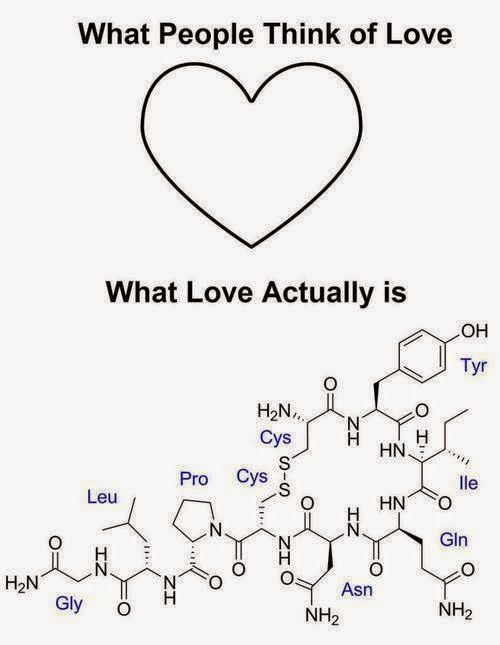
Scientists have also made great strides in elucidating the biochemical basis for love with the discovery of oxytocin, aka the “love hormone” or the “cuddle chemical”, which floods the brain during pair-bonding events, such as sex, childbirth, or eating a Reese's Peanut Butter Cup. In addition to forging pair bonds during sex, oxytocin appears to be instrumental in causing moms to love and care for their kids. Rat mothers given an agent that blocks oxytocin release disregard their newborn pups. There is even a review article on oxytocin written by a Dr. Love – no joke!

Lou Gramm of Foreigner once crooned, “I want to know what love is, I want you to show me.” Here you go, Lou.

So there you have it:  love is an evolutionary tactic that helps us propagate our genetic legacy. Let’s see Barry White work that into a song. It is not the most romantic answer, but remember…just because we know how the roller coaster works doesn’t make the ride any less thrilling.

*It should be noted that kin selection is seen in many species, and not just animals. For example, kin selection is seen in insects and even in plants!

Contributed by:  Bill Sullivan
(heart) Bill on Twitter.


Love TM (2014). Oxytocin, motivation and the role of dopamine. Pharmacology, biochemistry, and behavior, 119, 49-60 PMID: 23850525

van Leengoed E, Kerker E, & Swanson HH (1987). Inhibition of post-partum maternal behaviour in the rat by injecting an oxytocin antagonist into the cerebral ventricles. The Journal of endocrinology, 112 (2), 275-82 PMID: 3819639

Domingue, B., Fletcher, J., Conley, D., & Boardman, J. (2014). Genetic and educational assortative mating among US adults Proceedings of the National Academy of Sciences, 111 (22), 7996-8000 DOI: 10.1073/pnas.1321426111