Showing posts with label love. Show all posts

Wednesday, July 18, 2018

If Parasites Had Dating Profiles

Once upon a time, before the Internet, people actually had to venture outside to find a significant other. Popular places to find a potential mate included bars, dance clubs, dog parks, cafes, parties, and the gym. You’d have to work up the courage, and perhaps a cringe-worthy pick-up line, to ask another person out on a date. After an overpriced dinner and movie, you’d have to engage in lengthy conversation under a starry sky to learn about them.

But who has time for all that?! These days, you can simply screen dozens of candidates by reading their dating profiles on matchmaking web sites or apps like Tinder. This modern form of mate selection is unique to humans; imagine if other creatures in the natural world, like parasites, had to write dating profiles…

Toxoplasma gondii

Hanging with my BFFs in a tissue cyst.
We call ourselves "The Brady Bunch"!
Photo by David Ferguson (via EurekAlert)
Do you love cats? So do I! They’re my favorite animal, although I can weasel my way into any vertebrate animal that I want to, including weasels. That’s one of the reasons why I’m called “the most successful parasite on Earth.” I’m the clever parasite that has learned to manipulate the brains of rodents so that they become fearless morons around felines. Normally, mice and rats scurry away from the scent of a cat, but not when I’m in their head!

What turns me on? Long, romantic walks through the hollows of a cat’s innards. I like to groove under the moist sheets of their intestinal epithelium to the musical stylings of Cat Stevens. If we have kids, I promise to be a good parent and read Calvin and Hobbes to them all night long. I’ll be sure to kiss them goodbye before sending them out into the world to contaminate litter boxes, sandboxes, gardens, yards, and streams. Before long, our progeny will be inhaled or ingested by unsuspecting animals.

When I get into something that is not a cat, I get bored rather quickly and go to sleep. You can call me bradyzoite when I’m napping. Life in my intermediate host isn’t all that bad. I can pick pretty much whatever cell type I want and make it my room. The neurons in the brain are ideal because the pesky immune system tends to leave that organ alone, so I get plenty of peace and quiet. I just chill and wait for that animal to get eaten, hopefully by a cat so I can get my groove on again! What if another type of animal eats me instead? No biggie. I’m a patient parasite and will simply wait it out in another intermediate host.

Like I said before, if I landed in a rodent I know how to scramble their tiny brains to increase their chances of getting eaten by a hairball-coughing feline. The human brain is a tad more complex and taking me a little longer to figure out. While knocking around in a human head, I might have increased the risk of some people to develop schizophrenia or rage disorder. But ultimately, I’m trying to rewire the human brain so they leap into lion cages at the zoo.

In my spare time, I love to devour books instead of organ meat. My favorite books include Cat’s Cradle, The Pink Panther, The White Tiger, and of course The Cat in the Hat. I’m also writing my own book. It’s called If You Give A Mouse Toxoplasma…

Schistosoma mansoni

Come swim with Schisto!
Photo: http://schaechter.asmblog.org/.a/
6a00d8341c5e1453ef014e875d2f3e970d-popup
Escargot, anyone? My name is Schistosoma, but you can call me Schisto. I live in parts of South America and the Caribbean, Africa, and the Middle East. I hope you don’t think I’m being too fresh, but I’d love to start our date by skinny dipping in my favorite freshwater lake. After we’re done frolicking in the water, we’ll sneak into some snails and develop into cercariae. What? You’ve never been a cercariae before? Have no fear, my darling, I will teach you how to become one. Once we’re cercariae, we’ll break out of the snail and search for the definitive stop on our romantic adventure: an unsuspecting human swimming in our waters.

The cool thing about becoming cercariae is that we’ll look like a mermaid. We’ll gain a gorgeous forked tail that will help us swim around and find a suitable human to invade. I like to hum the theme to Jaws as I make my approach to the human creature! Do you know how many people are attacked by sharks each year? Only 75. I've infected well over 200 million people, but sharks get the scary theme song...go figure!

I think you’ll be surprised how easy it is to burrow into a human's skin – I prefer to enter through a hair follicle. They don’t feel a thing. Once we get inside a human, we can ditch our tails and I’ll give you a grand tour. After a few days gallivanting through the skin, we’ll hang out in the lungs, go through the heart, and then enjoy a bloodmeal as we take a ride in the circulatory system to the liver. This is the stop I find most arousing, and I’ll ask you to pair-bond with me. If you accept, we’ll celebrate by making our way to the veins draining the colon.

Why the veins of the colon? I’m glad you asked, my pet! You see, the colon is where the human stores his waste until he can’t hold it in any longer. We can easily send our eggs into his colon, giving our kids a free ride back out into the water so they can find snails of their own one day. It’s a strategy not unlike the one used by Han Solo in The Empire Strikes Back when he evaded the Star Destroyer by making it appear his ship was just a part of the Imperial garbage.

I think you’ll find that the chemistry between us is no fluke, but rather truly meant to be.

Trypanosoma cruzi

Come cruzi with me! I'm the cute wavy purple things!
Photo: Wikipedia Commons
What could be more romantic than a date that involves a “kissing” bug? That is where our enchanting evening shall begin. From inside the so-called kissing bug, we will watch it latch onto human flesh and suck its blood – cool, huh? After the kissing bug has its fill, it gets the urge to go to the bathroom, using the tiny wound it made as a toilet. That will be our cue to exit: out of the kissing bug, into the human – right through that convenient little hole the bug made in its flesh.

Once under the human’s skin, we’ll transform from trypomastigotes into amastigotes while inside the host’s cells. I hope you don’t think I’m being too prudish, but I’m really not all that into sex. I’d prefer that we multiply on our own, but how about this…we can watch each other divide!

After we make clones of ourselves, there will be too many for the host cell to hold. I just love it when a host cell pops, don’t you? As trypomastigotes again, we’ll be free floating in the blood, where we will hitch a ride when the next hungry bug comes along to “kiss” our human host.

I just hope the kids we leave behind don’t cause trouble. Most of the time when I go through a human, my kids get all rowdy and start having a bunch of kids of their own. The extensive damage they leave in their wake can cause serious problems for the human host, which they call Chagas disease.

While waiting for a kissing bug to pick me up, I enjoy listening to music. Some of my favorite songs include Kiss Me Deadly, Love Bites, and Blow Me (One Last Kiss).

Plasmodium falciparum

I'm a little camera shy, but I like these plushies of me
as they show my softer side!
Photo: Giant Microbes
If you have a fetish for vampires or other blood-sucking creatures, I am the parasite for you! My name is Plasmodium, but most people know me as malaria, which means “bad air.” I hasten to clarify: I do not suffer from flatulence or rancid breath. Before people realized I was a parasite, they attributed the cause of malaria to breathing in “bad air.”

Two of my favorite things in life are blood and sex. I use humans for blood and Anopheles mosquitoes for sex. You might not think that there is enough room in the gut of a mosquito to have a lot of great sex, but give me a chance and I’ll show you that size isn’t everything. After the love making, we’ll take a lovely stroll up to the mosquito’s salivary glands and take a little nap before dinner. While we’re in the salivary glands, you can call me sporozoite.

The mosquito will be our limo to a fine human restaurant where the blood flows like wine. We will get our wake-up call when the mosquito bites a person; then hang tight while we take an exhilarating slide down her proboscis and into a red river. After a quick pit stop in the liver to transform into merozoites and put on our bibs, we’ll jump back into the red river and take our pick at which blood cell we’d like to dine at first. All the hemoglobin you can eat! We will be the envy of Count Dracula!

In humans, red blood cells carry oxygen around the body, so as we destroy them, our human host will soon feel woozy, suffering from anemia, chills, and fever. But have no fear, as I’ll send out an SOS that changes our victim’s scent to be more attractive to mosquitoes. Before you know it, we’ll be pulled up into a fresh mosquito for some more amore.

I’m also a huge movie buff. My favorite movies are The Mosquito Coast, There Will Be Blood, Jungle Fever, and Red River.


Contributed by: Bill Sullivan
Follow Bill on Twitter.

Thursday, February 11, 2016

Unbreak My Heart: A Short History Of The Defibrillator and CPR

“Hearts cannot be broken, they're small squishy things
They don't break like glass but they bruise easily” – The Judybats


While hearts can’t be broken, their rhythmic beating can go awry – a condition we call arrhythmia. Many people don’t think of the heart as a muscle, but that’s what it is - a muscle that pumps blood around the body through a series of regular contractions. When the ventricles contract, oxygenated blood gets pumped out into circulation; when they relax, they fill back up with blood. Disruption of this routine delays delivery of blood to tissues and organs, including the brain.

Ventricular fibrillation is caused when a heart disorder leads to a problem with the electrical impulses running the cardiac muscles, which makes them quiver instead of contracting. A defibrillator basically sends an electric shock through the heart, stopping it in hopes that it starts back up with its normal rhythm restored. A remarkable feat that has saved tens of millions of lives, but how did we learn to do this?

Ventricular fibrillation usually occurs as a consequence of previous cardiac damage, such as a heart attack. But what about the pain that we feel when someone “breaks” our heart? Believe it or not, stress-induced cardiomyopathy, also known as “broken heart syndrome” is a real thing!
For centuries, it was believed that muscles used air or liquid to inflate. In the 1780s, Luigi Galvani “popped” this so-called “balloonist” theory by applying a newly discovered power called electricity to the leg muscles of a dead frog. In his experiments, Galvani stimulated limb muscles with heat, lancets, or chemical irritants…but only an electrified rod prompted those muscles to contract. This was a profound discovery that opened up a whole new field in medicine that studies the role of electricity in physiology (electrophysiology). And it raised an exciting question:  can electricity be used to reanimate life?   

Long ago, people used to believe muscles expanded and contracted because of air or fluid inside them. This was referred to as the “balloonist” theory.
Galvani’s nephew, Giovanni Aldini, set out to address that haunting question by performing what scientists were calling “Galvanic experiments”. In 1803, he freaked out a lot of people with a public demonstration involving the corpse of a freshly executed criminal and a pair of conducting rods hooked up to a battery. Aldini proceeded to touch the corpse at his mouth, ear, and, of course, his rectum. An eyewitness account documented the creepy results: “On the first application of the process to the face, the jaws of the deceased criminal began to quiver, and the adjoining muscles were horribly contorted, and one eye was actually opened. In the subsequent part of the process the right hand was raised and clenched, and the legs and thighs were set in motion.” (from the Newgate Calendar, January 18, 1803).

You might be wondering if Galvani or Aldini’s experiments inspired Mary Shelley’s 1818 classic, Frankenstein: or, The Modern Prometheus. While Shelley was aware of their work, electricity was not mentioned in her novel as the means by which Dr. Frankenstein’s creature was brought to life…that specific idea was incorporated later on when the story was made into a movie.
As dramatic as the “shocking” experiment was, the lesson was that electricity would not reanimate a corpse. So it wasn’t until 1930 that this sort of work was resurrected with simpler objectives:  using electric currents to kickstart a heart. Enter William Kouwenhoven, who invented the heart defibrillator, a device that essentially “restarts” the cardiac engine*. His experiments did not get off to a promising start. In 1928, high voltage shocks from electrodes placed on the head and one limb of a rat only resulted in a dead rat. But by 1933, he was able to restore normal heartbeats to dogs. However, this required direct contact with the dog’s heart muscle to work. This method of “open chest heart defibrillation” was practiced on patients until 1957, when Kouwenhoven built a device capable of delivering the electrical pulses from outside the body.


One of the first defibrillators by Kouwenhoven compared to what they look like today.
Kouwenhoven’s defibrillation studies also led to the development of cardiopulmonary resuscitation (CPR) as a critical life-saving technique. One fine Saturday – because all good scientists work through the weekends – a graduate student named Guy Knickerbocker noted a brief rise in blood pressure when he pressed those heavy copper defibrillator paddles onto the dog’s chest. This gave rise to the idea that by forcefully pressing on the chest, one could help circulate blood through the body until the heart started beating again.

*Kouwenhoven’s research stemmed from earlier findings, most notably those made by Jean-Louis Prevost and Frederic Batelli. In 1899, they observed that electrical shocks could induce ventricular fibrillation in dogs, but even larger shocks could restart their hearts.


Contributed by:  Bill Sullivan


Bresadola, M. (1998). Medicine and science in the life of Luigi Galvani (1737–1798) Brain Research Bulletin, 46 (5), 367-380 DOI: 10.1016/S0361-9230(98)00023-9

Thursday, February 12, 2015

Happy Valentine's Day! What Is Love, Anyway?

Many an ‘80s band has pondered the timeless question:  Howard Jones asked “What is Love”, Foreigner lamented “I Want To Know What Love Is”, and both Survivor and Whitesnake wondered “Is This Love”, just to name a few. Recently, a pair of skeletons was discovered in Leicestershire, England, holding hands for the past 700 years. Well, either that or they were thumb-wrestling enthusiasts.

"I wanna hold your hand"
It is hard for us humans to imagine a world without love, but the universe has been going about its business with complete dispassion for billions of years. The appearance of life on Earth did little to change that at first, but after a couple billion years, life forms began to emerge with brains sophisticated enough to make love possible. So it is clear that love is not requisite for life; for every animal that can experience love, there are billions of bacteria living with that animal that do just fine without it.

Many of Earth’s creatures thrive without any need for love.

Granted, bacteria divide asexually, so there is no need to wine and dine a partner who is probably not going to return your 33 calls anyway. You might think that love is needed for sex, but many life forms that have sex, including parasites, plants, insects, and frat boys, do so without love, further begging the question:  why does love exist?

At first sight, love would seem to be counterintuitive to evolution, which is often characterized as the “blind watchmaker” driven by “selfish genes” tinkering to build the fittest survival machine. However, love can confer extraordinary benefits to its practitioners, which is especially important when their offspring are unfit to survive on their own after birth. Most scientists agree that love evolved to prompt species to protect their offspring (this is known as kin selection*), and this altruistic behavior often extends to others who share similar genes. A recent study from April of this year has indeed shown that spouses tend to have similar DNA, and we reported a study a few weeks ago about friends having similar DNA. In other words, an objective analysis reveals that love is a stealthy manipulation orchestrated by selfish genes in order to trick us into protecting their legacy.

Certain dating web sites are capitalizing on the discovery that spouses share highly similar DNA. You can find your genetic soul mate by viewing the genes of potential partners as you check out what they look like in tight jeans.

Back in the 80s we didn’t have technology that could identify our genetically compatible companion, so we had to rely on the wisdom of the great philosopher Sammy Hagar to teach us how we know “When It’s Love”.


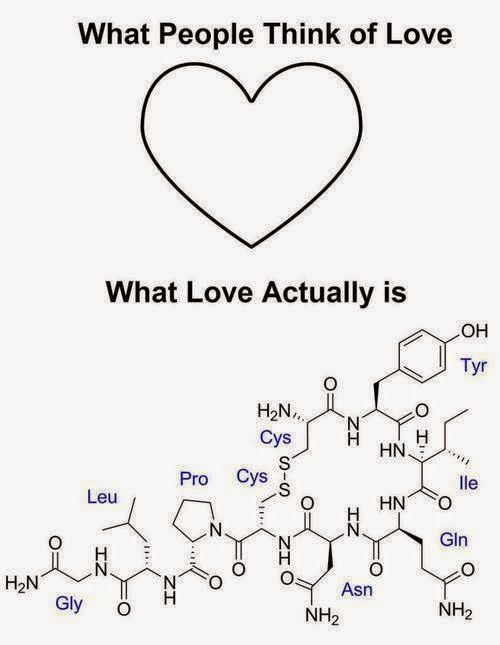
Scientists have also made great strides in elucidating the biochemical basis for love with the discovery of oxytocin, aka the “love hormone” or the “cuddle chemical”, which floods the brain during pair-bonding events, such as sex, childbirth, or eating a Reese's Peanut Butter Cup. In addition to forging pair bonds during sex, oxytocin appears to be instrumental in causing moms to love and care for their kids. Rat mothers given an agent that blocks oxytocin release disregard their newborn pups. There is even a review article on oxytocin written by a Dr. Love – no joke!

Lou Gramm of Foreigner once crooned, “I want to know what love is, I want you to show me.” Here you go, Lou.

So there you have it:  love is an evolutionary tactic that helps us propagate our genetic legacy. Let’s see Barry White work that into a song. It is not the most romantic answer, but remember…just because we know how the roller coaster works doesn’t make the ride any less thrilling.

*It should be noted that kin selection is seen in many species, and not just animals. For example, kin selection is seen in insects and even in plants!
Contributed by:  Bill Sullivan
(heart) Bill on Twitter.


Love TM (2014). Oxytocin, motivation and the role of dopamine. Pharmacology, biochemistry, and behavior, 119, 49-60 PMID: 23850525

van Leengoed E, Kerker E, & Swanson HH (1987). Inhibition of post-partum maternal behaviour in the rat by injecting an oxytocin antagonist into the cerebral ventricles. The Journal of endocrinology, 112 (2), 275-82 PMID: 3819639

Domingue, B., Fletcher, J., Conley, D., & Boardman, J. (2014). Genetic and educational assortative mating among US adults Proceedings of the National Academy of Sciences, 111 (22), 7996-8000 DOI: 10.1073/pnas.1321426111

Wednesday, October 1, 2014

What Is Love, Anyway?

Many an ‘80s band has pondered the timeless question:  Howard Jones asked “What is Love”, Foreigner lamented “I Want To Know What Love Is”, and both Survivor and Whitesnake wondered “Is This Love”, just to name a few. Recently, a pair of skeletons was discovered in Leicestershire, England, holding hands for the past 700 years. Well, either that or they were thumb-wrestling enthusiasts.

"I wanna hold your hand"
It is hard for us humans to imagine a world without love, but the universe has been going about its business with complete dispassion for billions of years. The appearance of life on Earth did little to change that at first, but after a couple billion years, life forms began to emerge with brains sophisticated enough to make love possible. So it is clear that love is not requisite for life; for every animal that can experience love, there are billions of bacteria living with that animal that do just fine without it.

Many of Earth’s creatures thrive without any need for love.

Granted, bacteria divide asexually, so there is no need to wine and dine a partner who is probably not going to return your 33 calls anyway. You might think that love is needed for sex, but many life forms that have sex, including parasites, plants, insects, and frat boys, do so without love, further begging the question:  why does love exist?

At first sight, love would seem to be counterintuitive to evolution, which is often characterized as the “blind watchmaker” driven by “selfish genes” tinkering to build the fittest survival machine. However, love can confer extraordinary benefits to its practitioners, which is especially important when their offspring are unfit to survive on their own after birth. Most scientists agree that love evolved to prompt species to protect their offspring (this is known as kin selection*), and this altruistic behavior often extends to others who share similar genes. A recent study from April of this year has indeed shown that spouses tend to have similar DNA, and we reported a study a few weeks ago about friends having similar DNA. In other words, an objective analysis reveals that love is a stealthy manipulation orchestrated by selfish genes in order to trick us into protecting their legacy.

Certain dating web sites are capitalizing on the discovery that spouses share highly similar DNA. You can find your genetic soul mate by viewing the genes of potential partners as you check out what they look like in tight jeans.

Back in the 80s we didn’t have technology that could identify our genetically compatible companion, so we had to rely on the wisdom of the great philosopher Sammy Hagar to teach us how we know “When It’s Love”.


Scientists have also made great strides in elucidating the biochemical basis for love with the discovery of oxytocin, aka the “love hormone” or the “cuddle chemical”, which floods the brain during pair-bonding events, such as sex, childbirth, or eating a Reese's Peanut Butter Cup. In addition to forging pair bonds during sex, oxytocin appears to be instrumental in causing moms to love and care for their kids. Rat mothers given an agent that blocks oxytocin release disregard their newborn pups. There is even a review article on oxytocin written by a Dr. Love – no joke!

Lou Gramm of Foreigner once crooned, “I want to know what love is, I want you to show me.” Here you go, Lou.

So there you have it:  love is an evolutionary tactic that helps us propagate our genetic legacy. Let’s see Barry White work that into a song. It is not the most romantic answer, but remember…just because we know how the roller coaster works doesn’t make the ride any less thrilling.

*It should be noted that kin selection is seen in many species, and not just animals. For example, kin selection is seen in insects and even in plants!

Contributed by:  Bill Sullivan
(heart) Bill on Twitter.


Love TM (2014). Oxytocin, motivation and the role of dopamine. Pharmacology, biochemistry, and behavior, 119, 49-60 PMID: 23850525

van Leengoed E, Kerker E, & Swanson HH (1987). Inhibition of post-partum maternal behaviour in the rat by injecting an oxytocin antagonist into the cerebral ventricles. The Journal of endocrinology, 112 (2), 275-82 PMID: 3819639

Domingue, B., Fletcher, J., Conley, D., & Boardman, J. (2014). Genetic and educational assortative mating among US adults Proceedings of the National Academy of Sciences, 111 (22), 7996-8000 DOI: 10.1073/pnas.1321426111

Friday, August 15, 2014

The Friday Five

Highlighting some of the coolest science news we’ve seen lately.

1. Ever wonder if a blood-sucking insect gets drunk after sucking an intoxicated person’s blood?


2. You can't hurry love...but scientists have calculated how many soul mates you have in the world. Find out how they did this and how many are waiting for you. Go get 'em, tiger, then play them this song!


3. First, scientists made the "nude" mouse, and now they made one that is see through! Scientists have also recently created the invisible mouse, but no one can seem to find it (ba dum dum).


4. Scientists have reported that the memory of starvation can be inherited through the passage of small RNAs to offspring...for at least three generations (in worms, at least). You're not only what you eat, but you're what your great great grandparents ate!

5. It's not all in your head...music can make you feel powerful – especially pumping up the bass! Rock on, tiger.


Bonus!
Last month we wrote about the sequencing of Ozzy Osbourne’s genome. Here is a great video explaining how the human genome is sequenced.


Science quote of the week:
“All of science is nothing more than the refinement of everyday thinking.” –Albert Einstein

Contributed by:  Bill Sullivan

Follow Bill on Twitter: @wjsullivan


Rechavi, O., Houri-Ze’evi, L., Anava, S., Goh, W., Kerk, S., Hannon, G., & Hobert, O. (2014). Starvation-Induced Transgenerational Inheritance of Small RNAs in C. elegans Cell, 158 (2), 277-287 DOI: 10.1016/j.cell.2014.06.020

Yang B, Treweek JB, Kulkarni RP, Deverman BE, Chen CK, Lubeck E, Shah S, Cai L, & Gradinaru V (2014). Single-Cell Phenotyping within Transparent Intact Tissue through Whole-Body Clearing. Cell PMID: 25088144

Hsu, D., Huang, L., Nordgren, L., Rucker, D., & Galinsky, A. (2014). The Music of Power: Perceptual and Behavioral Consequences of Powerful Music Social Psychological and Personality Science DOI: 10.1177/1948550614542345