Showing posts with label psychology. Show all posts

Thursday, September 14, 2017

Awkward To Awesome: Dr. Ty Tashiro on Communicating the Science of Being Awkward

Ty Tashiro knows awkward. As he charmingly admits in his second book, Awkward: The Science of Why We’re Socially Awkward and Why That’s Awesome, he was no stranger to deviating from the norm. But he soon realized that the same characteristics that make awkward people stick out like a sore thumb also make them stand out in the most amazing ways. Ty’s awkward ways earned him a Ph.D. in Psychology from the University of Minnesota, and then he became an award-winning professor at the University of Maryland and University of Colorado.


Ty Tashiro (photo by Brandi Nicole)

Ty is also passionate about science communication, eager to tell the world about fascinating new work in psychology. His first book was The Science of Happily Ever After, which is a scientific guide to finding everlasting love. His work has been featured in the New York Times, the Washington Post, Time.com, TheAtlantic.com, and on NPR and Sirius XM Stars radio. Ty kindly agreed to answer a few of our questions about his latest research into awkwardness and why he decided to write popular science.
Awkward Can Be Awesome!
Sullivan:  In your book, you comically describe several instances where you yourself have felt awkward. Tell us more about the ways that awkward can be awesome.
Tashiro:  I think a sense of levity with one’s awkwardness is helpful for everyone because who hasn’t had a blush-worthy awkward moment that turned into a great story? There’s nothing wrong with being awkward, but it’s helpful for awkward people to understand their unique attributes that can be leveraged to accomplish extraordinary outcomes.
I like to explain what social scientists have discovered about social awkwardness with a spotlight analogy. Imagine that you see life unfold on a stage and that stage is broadly illuminated. You could easily shift your attention as people enter or exit the stage, watch the key interactions at center stage, and pick up on the context around center stage. That’s how most people see the social world.
Awkward people see their stage spotlighted and their sharply focused beam of attention tends to fall a little left of center stage. So, they’re more likely to miss some of the key social information at center stage, but whatever falls under their spotlighted attention is seen with great focus and potentially a brilliant clarity. This spotlighted perspective manifests in behaviors such as intense focus, persistence, and even an unusual level of enthusiasm for the things they love.
There are interesting behavioral genetic and developmental psychology studies that show a moderate, but robust association between social awkwardness and striking talent, which is a way to describe people who show exceptional ability or achievement in a specific area. Although some of this correlation is accounted for by I.Q., the stronger mediator is their obsessive drive to learn everything they can and master their area of interest.

Are Science Nerds Real?
Sullivan:  This certainly doesn’t apply to all scientists, but I know many who would describe themselves as socially awkward. Do you have a sense as to why scientists might be disproportionately awkward?
Tashiro:  Simon Baron-Cohen and his colleagues have been at the forefront of understanding people with social skill deficits, communication difficulties, and the kind of obsessive interest that characterize socially awkward people. In a series of studies, they compared the degree of awkward characteristics among Oxford students majoring in the humanities, sciences, computer science, and a group of high school students involved with their school’s math competitions. What they found was that compared to humanities majors, those students majoring in sciences, computer science, and the matheletes reported significantly more awkward characteristics.
Follow-up studies suggest that people with awkward characteristics tend to think in a more systematic or methodical manner, which is a style of problem-solving that is well-suited to fields like science, computers, or math that employ things like the scientific method or orders of operation.
Awkward people love to take things apart, intensively study how the pieces function, then put those pieces together in a way that makes more sense. In this way, the awkward mind can be advantageous for someone who is passionate about describing, organizing, and predicting phenomena.


Ty Tashiro’s second book, Awkward: The Science of Why We’re Socially Awkward and Why That’s Awesome, examines what it means to be awkward and how those traits also often lead to success.

Antidote for the Esoteric.
Sullivan:  Being socially awkward might hinder one’s ability to communicate research effectively. Do you have any advice for people who fall into that category?
Tashiro:  The risk for any awkward person is to fall too far down the rabbit hole. Researchers are rewarded for being meticulous about details, learning how to effectively use the specific terminology in their subfield, and being hyper-aware of methodological nuances. None of these qualities should be compromised because they are necessary for great science, but it’s also easy to see how the best of us could get so deep into their field of research that they forget what the non-specialist wants to know or needs to know.
Part of the problem is that a great lab usually means that the Principal Investigator manages an army of graduate students, post-docs, and undergraduate research assistants. With the time pressures and publication pressures, the P.I. gets data or results, but begins to lose an opportunity to be hands on.
I remember hearing a story in graduate school about Harry Harlow, who is famous for his early primate studies that showed infant primates preferred a cloth surrogate mother that provided tactile comfort to a surrogate mother that provided food. My professor was an emeritus faculty at Minnesota who told us that the spark for Harlow’s idea occurred while he was cleaning the cages of the primates, a task usually reserved for research assistants. Harlow noticed that the primates resisted when he tried to remove the towels from the bottom of their cages. Harlow’s willingness to immerse himself with his subjects allowed him to see a pragmatic, but revolutionary insight.

Why SciComm? 
Sullivan:  What motivated you to write about science for a broader audience?
Tashiro:  When I was an assistant professor at the University of Maryland, I loved teaching an undergraduate course about the psychology of interpersonal relationships because the students asked incisive, practical questions that often left me speechless or inarticulate. I could walk them through a compelling, programmatic area of research and they would politely ask me, “So what?”
These students wanted to know how evolutionary research applied to their mate preferences on Friday night or how they could apply social psychology studies of persuasion to help a friend out of an unhealthy relationship. My answers were not always satisfactory, so maybe out of stubbornness I decided to tackle the problem of translating great social science into practical advice. While we usually think of translational research as the gap between basic and applied science, my translational task has generally been to bridge the gap between applied research and the general public.

Ty’s Tips for Science Writers.
Sullivan:  What tips can you give aspiring science communicators?
Tashiro:  I’ll start with the bad news, then give you the good news. As I began investigating how to write in a compelling manner for broad audiences, I realized that the cornerstones of great storytelling are rich scenes, complex characters, and brisk plot. Then, I realized that science writing for journals has no scene, character, or plot. Some people might protest that the materials, subjects, and procedures count, but that’s a stretch.
I should be clear that I don’t think science writers should change how they write for journals or their colleagues. There’s a precision and factual nature to good science writing that is valuable and necessary, but it’s a style that does not appeal to broad audiences. So, the starting point for aspiring science communicators is to think about how to infuse scene, character, and plot into the scientific narrative.
My strategy has been to open every chapter with a story that is humorous or mysterious and this story sets up a research problem. In AWKWARD, I set up the descriptive statistics chapter with a middle school mishap involving awkward all-star wrestling re-enactments that ended with me concussed. I set up the social neuroscience chapter with a story about my first middle school slow dance that left readers wondering whether the boy should kiss the girl.
Both stories are absurd, mildly embarrassing for me, but they allow me to get readers invested in a character who needs to solve a conundrum. The middle parts of my chapters give readers research findings that help them piece together clues about why I ended up concussed or whether I should go in for the kiss. I end each chapter by giving the reader the outcome from the opening story, which allows me to summarize the data through the lens of a character trying to take appropriate action on a scene.
For researchers in physics, biology, or other fields that do not always involve human subjects, you sometimes end up anthropomorphizing molecules or species, but this can provide a wonderful opportunity for fanciful, unexpected storylines.
As science comes under siege these days, it’s more important than ever for the science community to cooperate and find a way to captivate the broader public with science and to share the wonderful discoveries you’ve observed under your brilliant spotlight.

This article originally appeared on PLOS SciComm Blogs.

Bill Sullivan


Bill Sullivan is Showalter Professor at Indiana University School of Medicine, where he studies infectious disease. Bill has published over 70 papers in scientific journals and written for Scientific American, Scientific American MIND, Salon.com, GotScience.org, What Is Epigenetics, and more. He also maintains his own popular science blog called THE ‘SCOPE. Bill received his Ph.D. in Molecular & Cell Biology from the University of Pennsylvania.

Thursday, March 23, 2017

Bugs To Drugs: Can Probiotics Treat Depression?


Depression is a debilitating mental illness that affects up to 15 million Americans in the US alone, yet we are far from understanding the root cause. Multiple genes have been associated with depression, but whether these genes produce symptoms depends on the individual’s environment. New research is showing that one of the biggest environmental factors impinging on mental health comes from within.

Our body is home to trillions of microscopic creatures, mostly bacteria, which are collectively referred to as our microbiota. As unsettling as that may sound, these microbes are not necessarily the kind we want to evict from our body. The bacteria dwelling within our gut serve many important functions; for example, they help digestion, produce vitamins, and keep other types of microbes that cause disease at bay.

Our microbial inhabitants bring countless additional genes into our body called the “microbiome.” These microbial genes can be considered an extension of our own DNA – a so-called “second genome.” In other words, your body is not only influenced by the genes in your DNA, but it can also be affected by genes carried by your microbiota. These microbial genes not only affect physical health, but may also alter your mood and personality.


It is convenient to refer to species of our microbiota as "good" or "bad", but in reality they are neither. There are bacteria that can cause serious disease, like C-diff, but usually only after the microbiota has been disrupted (e.g. after prolonged antibiotic treatment). Likewise, "good" bacteria like E. coli can cause life-threatening disease under the right circumstances.  
Our microbiota help produce surprising amounts of neurotransmitters – chemicals that function in brain signaling. When laboratories produce “germ-free” mice by raising them in sterile environments, the mice exhibit strange neurological issues. Lacking their gut microbiota, germ-free mice do not respond to stress properly. These studies have given rise to the concept of the “gut-brain” axis, a conduit of biochemical communication between these organ systems. Such an axis exists in people too, as researchers have noted a strong correlation between intestinal problems and mental illness. For example, anxiety and depressive disorders are associated with both irritable bowel syndrome and ulcerative colitis.

A study by Ioana A. Marin and colleagues at the University of Virginia, published on March 7, 2017 in Scientific Reports, provides new evidence that intestinal bacteria influence mental disorders such as depression. In this experiment, mice were subjected to unpredictable chronic mild stress (UCMS), which involves strobe lights, irritating noise, cage tilting, and crowded conditions. Kind of like being shoved into noxious nightclubs against your will at random times throughout the day.

Unlike Disco Mickey, laboratory mice become stressed out when subjected to stimuli that resemble your average nightclub.
Over time, mice subjected to UCMS begin to show symptoms that resemble depression in humans. The researchers look for “despair behavior,” which can be detected in a number of ways. In this study, the mice were placed in a tub of water to evaluate despair behavior. Unstressed mice quickly swam to a platform and escaped, but the stressed mice did not make a strong effort to escape and had to be rescued from the tub.

The researchers then compared what the intestinal microbiome looked like in stressed versus unstressed mice. The different species of bacteria comprising the microbiota can be determined by sequencing the DNA in mouse droppings. Each species has a signature DNA sequence that serves as an identifier for that type of bacteria.

The results showed that stress altered the mouse microbiome by reducing a type of bacteria called Lactobacillus. It might have occurred to you that stress could have simply changed the eating habits of the mice, which in turn would affect the composition of the microbiome, but the researchers did not observe any change in eating habits or weight of the stressed mice. Furthermore, when they administered Lactobacillus as a probiotic, the symptoms of depression improved.

Why would stress cause changes in the microbiome? No one knows for sure, but this could be a result of altered brain chemistry making the gut less hospitable to some bacteria. Researchers also noted that intestinal physiology was altered in the stressed animals, which could have played a role in microbiota changes.


When someone consumes a probiotic they are ingesting live bacteria. That concept should no longer gross you out. Probiotics include the so-called "good" bacteria that have been shown to confer health benefits in some studies. These bacteria can be delivered into your body in numerous ways, including food (like yogurt) or pills.  
Does this mean you should rush out to purchase probiotics to battle depression? There are important caveats to studies like this that should be considered. The study was performed in a mouse model of depression, which may not fully represent the condition in humans. The microbiome of controlled laboratory animals is more uniform than humans, who tend to have vastly different bacteria in their guts depending on such things as diet, geography, illness, and age.

However, a 2016 meta-analysis (a study of studies) concluded that “probiotics were associated with a significant reduction in depression [in humans], underscoring the need for additional research on this potential preventive strategy for depression.” While that sounds encouraging, we are far from understanding how certain bacteria may ameliorate depression and whether this affect holds up in diverse patient populations. Probiotics certainly should not replace the more rigorously established treatments for depression recommended by health professionals.

Bill Sullivan is a professor at the Indiana University School of Medicine. Follow him on Twitter @wjsullivan.

Thursday, May 14, 2015

Darwin Can Dance! The Evolution Of Pop Music

Why do most people over 40 hate today’s music? Why do your grandparents keep playing their “Malt Shop Memories” CDs? Why does your mom start dancing when she hears Wham! and your dad start nodding his head wildly when he hears Motley Crue? Why does your Uncle never shut up about how Nirvana was the greatest band ever because they "changed everything"? 

As evidenced by their song, "Do The Evolution", Pearl Jam appears to be well-versed in evolutionary theory. But was the advent of grunge the most radical change in the course of modern music history?
Despite the cliché, the song does not remain the same. Just like biological organisms, music evolves - and where there is evolution, there is science. The modern rock band, As I Lay Dying, sings it best: “The Only Constant Is Change”. 

As I Lay Dying is not the kind of music your parents are going to understand. You can hear them now as they cover their ears, “Turn off that racket! My ears are bleeding! You call that singing? He’s just screaming! Back in my day…” and so on.

Elvis Presley is commonly known as “The King of Rock and Roll” for popularizing a groundbreaking style of music in the 1950s that fused rockabilly, country, and rhythm & blues. To this day, he remains the best selling musical artist of all time, having sold in excess of 600 million records.

With this extraordinary popularity, you’d think that his type of music would still be going strong, but one look at today’s pop music chart and you’ll quickly see that there is little on there that resembles the music Elvis brought to the world. On the contrary, there are styles of music on the charts now that Elvis never could have imagined. At the time this article was written, the #1 song on the Top 100 Billboard chart is “See You Again”, which sounds nothing like the music that was popular prior to the 1990s.

While the reason remains debatable, there’s no question that music changes over time. However, our favorite music tends to be what was popular during the most impressionable years of our youth, between ages 12 and 22. Music heard during that window in our lives appears to get hardwired into our brain, forever serving as a powerful stimulus for dopamine release, a neurotransmitter that makes us feel pleasantly satisfied (perhaps "comfortably numb").

In a new study published in Royal Society Open Science, evolutionary biologists and computer scientists “come together” to advance our understanding of pop music’s evolution. The researchers analyzed 17,000 songs from the US Billboard Hot 100 charts from 1960 to 2010 in order to identify the greatest musical revolution in recent US music history. Was it the famous “British Invasion” led by the Beatles and the Rolling Stones in the 1960s?
Was it the rise of disco in the 1970s, led by the Bee Gees, Village People, and KC & the Sunshine Band, or maybe the earth-shattering hard rock of Led Zeppelin?


Could it be the rise of synth-pop and electronic music by the likes of Madonna, Duran Duran, or Howard Jones in the 1980s?

How about the meteoric rise of those late 80s hairbands like Bon Jovi, Poison, or Warrant?
Or maybe it was the gritty angst of grunge that blasted onto the scene with Nirvana, Alice in Chains, Pearl Jam, and Soundgarden?
None of the above is correct, at least according to the criteria used by the authors of the study, which employed “cutting edge methods from signal processing and text-mining to analyze the musical properties of songs. Their system automatically grouped the thousands of songs by patterns of chord changes and tone allowing researchers to statistically identify trends with an unprecedented degree of consistency.”

The biggest upheaval occurred in 1991, but not with grunge…it was with hip-hop. Starting in the mid-80s, rap and hip-hop began climbing a steady ladder to the mainstream, with the help of artists like Run-DMC, Beastie Boys, Salt-N-Pepa, and LL Cool J. But 1991 was a watershed year with huge breakthroughs for hip-hop artists like N.W.A., Ice Cube, Ice-T, 2Pac, TLC, and Public Enemy. The radical changes in lyrical content and delivery, arrangement, and the diversity of sounds culminated to make hip-hop one of the most innovative changes to music in recent history.


With these powerful tools to analyze how music has evolved over the past 50 years, one has to wonder if it is possible to predict how music might sound in 2065.

Contributed by:  Bill Sullivan

References: 


Matthias Mauch, Robert M. Maccallum, Mark Levy, Armand M. Leroi. The evolution of popular music: USA 1960–2010. Royal Society Open Science, May 2015 DOI: 10.1098/rsos.150081
Salimpoor, V., Benovoy, M., Larcher, K., Dagher, A., & Zatorre, R. (2011). Anatomically distinct dopamine release during anticipation and experience of peak emotion to music Nature Neuroscience, 14 (2), 257-262 DOI: 10.1038/nn.2726

Thursday, April 23, 2015

And I Keep Hitting Re-peat-peat-peat-peat-peat-peat

We all do it…whether it is driving the same route to work every morning regardless of how much traffic is present, picking up your afternoon coffee/tea/soda even though you know you will need to pee on the drive home, or stopping by McDonalds for a quick bite even though the food is awful. We all have bad habits. Sometimes these habits are much easier to spot from the outside. For instance, who hasn’t questioned Selena Gomez’s habitual boyfriend choice of Justin Bieber? From the outside it seems so obvious…just quit him or it: whatever it is. But it must be more difficult than it sounds, I mean why else am I drinking my afternoon tea as I write this?


That pretty much sums it all up. I keep hittin’ re-peat-peat-peat-peat-peat-peat.
Habits, good or bad, are behaviors that have become automated. They are activities that were once goal-oriented that now occur in response to a stimulus, activities that we do without really thinking about outcomes. For example, I would get thirsty in the middle of the day after eating lunch, which led me to consciously get a drink in the afternoon. Now getting an afternoon drink has become routine – a habit. Regardless of whether I am thirsty or not, I grab a drink in the afternoon. This has become problematic as I am attempting to be healthier and drinking more water in the morning; hence my problem when I drive home.

The exact mechanisms by which a goal-oriented activity becomes a habit are not well understood. Recent studies have demonstrated a shift in brain activity: while goal-oriented, conscious activity stimulates the prefrontal cortex (the place in the brain where decisions are made), habits are traced to the basal ganglia, which plays a role in emotions, voluntary motor movements, and certain types of learning (Graybiel, 2008; Yin and Knowlton, 2006).


Well, maybe I should just grab a smaller tea, one that isn’t larger than my stomach…
So, why do we form habits? Since habits are generally formed from goal-oriented activities, we receive a reward when we perform these behaviors. For example, drinking tea quenches thirst. This reinforces the thought process in our brains leading to habit formation. But then one has to wonder: why do we maintain bad habits that don’t stimulate reward anymore?

Most of these habits, like smoking or eating junk food, once came with a reward – perhaps the idea of looking cool or a quick way to stifle hunger, respectively. Regardless of whether it may be harmful or whether your opinion changes about what is cool, once the habit is formed it is very difficult to break.

Another explanation for persistent bad habits is the concept called “sunk cost fallacy”. Sunk cost fallacy is the idea that once you have invested in something you are compelled to see it through, even if the benefit remains elusive. For example, how many of us have eaten to the point of bursting our jeans at an all-you-can-eat buffet? I know I have (it’s all you can eat, not eat all you can!). We feel we have to get the most bang for our buck, even if it means we’ll be spending more money to buy antacids later. The same concept holds true for some habits - it may be difficult to stop a habit once you have invested in that behavior. I know I will continue drinking this tea because I already bought it. Selena Gomez may feel she has already invested so much in Justin Bieber that it doesn’t seem right to just give him up.

Interestingly, studies have shown that other animals, including pigeons, are also affected by the sunk cost fallacy (White and Magalhaes, 2015). In this study, pigeons were given a reward (food) after pecking a button a few times. The scientists then introduced a second button and varied how many pecks it took to receive food, one requiring only a few pecks and the other requiring up to 30. Pigeons were more likely to stick with whichever button they initially chose, regardless of how many pecks it took to get the food. In other words, after investing in an option that works, pigeons were less likely to change course and expend energy exploring other options. So maybe we can blame our inability to break bad habits on ancient evolutionary echoes of our animal instincts?
 
Scientists have shown pigeons also fall prey to "sunk cost fallacy", providing a fertile ground for bad habits to take root.
 
Habits are routines; they are triggered by a reoccurring stimulus. So how do we break them? It is difficult to break habits because you perform them without thinking. Simply being aware of what triggers your habit will help you break it (Quinn et al., 2010). So next time you find yourself stopping at McDonalds or grabbing that unhealthy snack, think about what just happened. What triggered your desire? Force your brain not to take the short cut or easy way out, but to think objectively about your choice and the ensuing outcomes.

 
Studies have also indicated that the best time to break a habit is when you go on vacation because you are changing up your routine - you won’t have the same stimulus or trigger provoking your habit (Gross, 2012). So I guess to break my afternoon tea habit I should take a week and go to Hawaii…yeah, I like the sound of that.
 

This is where I will be until I break my tea habit. I kind of hope it takes awhile.
 
Contributed by: Sarah Deffit
 

Graybiel AM (2008). Habits, rituals, and the evaluative brain. Annual review of neuroscience, 31, 359-87 PMID: 18558860

Quinn JM, Pascoe A, Wood W, & Neal DT (2010). Can't control yourself? Monitor those bad habits. Personality & social psychology bulletin, 36 (4), 499-511 PMID: 20363904

White KG, & Magalhães P (2015). The sunk cost effect in pigeons and people: a case of within-trials contrast? Behavioural processes, 112, 22-8 PMID: 25305066

Yin HH, & Knowlton BJ (2006). The role of the basal ganglia in habit formation. Nature reviews. Neuroscience, 7 (6), 464-76 PMID: 16715055

Gross, T. Habits: How They Form And How To Break Them. NPR (2012). http://www.npr.org/2012/03/05/147192599/habits-how-they-form-and-how-to-break-them

Thursday, February 12, 2015

Happy Valentine's Day! What Is Love, Anyway?

Many an ‘80s band has pondered the timeless question:  Howard Jones asked “What is Love”, Foreigner lamented “I Want To Know What Love Is”, and both Survivor and Whitesnake wondered “Is This Love”, just to name a few. Recently, a pair of skeletons was discovered in Leicestershire, England, holding hands for the past 700 years. Well, either that or they were thumb-wrestling enthusiasts.

"I wanna hold your hand"
It is hard for us humans to imagine a world without love, but the universe has been going about its business with complete dispassion for billions of years. The appearance of life on Earth did little to change that at first, but after a couple billion years, life forms began to emerge with brains sophisticated enough to make love possible. So it is clear that love is not requisite for life; for every animal that can experience love, there are billions of bacteria living with that animal that do just fine without it.

Many of Earth’s creatures thrive without any need for love.

Granted, bacteria divide asexually, so there is no need to wine and dine a partner who is probably not going to return your 33 calls anyway. You might think that love is needed for sex, but many life forms that have sex, including parasites, plants, insects, and frat boys, do so without love, further begging the question:  why does love exist?

At first sight, love would seem to be counterintuitive to evolution, which is often characterized as the “blind watchmaker” driven by “selfish genes” tinkering to build the fittest survival machine. However, love can confer extraordinary benefits to its practitioners, which is especially important when their offspring are unfit to survive on their own after birth. Most scientists agree that love evolved to prompt species to protect their offspring (this is known as kin selection*), and this altruistic behavior often extends to others who share similar genes. A recent study from April of this year has indeed shown that spouses tend to have similar DNA, and we reported a study a few weeks ago about friends having similar DNA. In other words, an objective analysis reveals that love is a stealthy manipulation orchestrated by selfish genes in order to trick us into protecting their legacy.

Certain dating web sites are capitalizing on the discovery that spouses share highly similar DNA. You can find your genetic soul mate by viewing the genes of potential partners as you check out what they look like in tight jeans.

Back in the 80s we didn’t have technology that could identify our genetically compatible companion, so we had to rely on the wisdom of the great philosopher Sammy Hagar to teach us how we know “When It’s Love”.


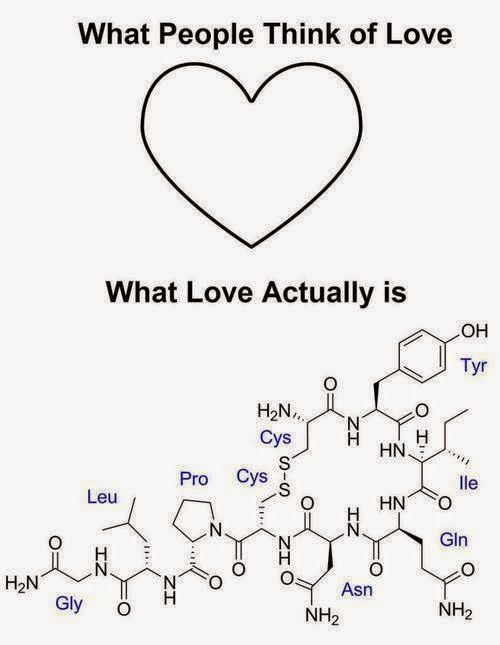
Scientists have also made great strides in elucidating the biochemical basis for love with the discovery of oxytocin, aka the “love hormone” or the “cuddle chemical”, which floods the brain during pair-bonding events, such as sex, childbirth, or eating a Reese's Peanut Butter Cup. In addition to forging pair bonds during sex, oxytocin appears to be instrumental in causing moms to love and care for their kids. Rat mothers given an agent that blocks oxytocin release disregard their newborn pups. There is even a review article on oxytocin written by a Dr. Love – no joke!

Lou Gramm of Foreigner once crooned, “I want to know what love is, I want you to show me.” Here you go, Lou.

So there you have it:  love is an evolutionary tactic that helps us propagate our genetic legacy. Let’s see Barry White work that into a song. It is not the most romantic answer, but remember…just because we know how the roller coaster works doesn’t make the ride any less thrilling.

*It should be noted that kin selection is seen in many species, and not just animals. For example, kin selection is seen in insects and even in plants!
Contributed by:  Bill Sullivan
(heart) Bill on Twitter.


Love TM (2014). Oxytocin, motivation and the role of dopamine. Pharmacology, biochemistry, and behavior, 119, 49-60 PMID: 23850525

van Leengoed E, Kerker E, & Swanson HH (1987). Inhibition of post-partum maternal behaviour in the rat by injecting an oxytocin antagonist into the cerebral ventricles. The Journal of endocrinology, 112 (2), 275-82 PMID: 3819639

Domingue, B., Fletcher, J., Conley, D., & Boardman, J. (2014). Genetic and educational assortative mating among US adults Proceedings of the National Academy of Sciences, 111 (22), 7996-8000 DOI: 10.1073/pnas.1321426111