Showing posts with label Valentine's Day. Show all posts

Thursday, February 11, 2016

Unbreak My Heart: A Short History Of The Defibrillator and CPR

“Hearts cannot be broken, they're small squishy things
They don't break like glass but they bruise easily” – The Judybats


While hearts can’t be broken, their rhythmic beating can go awry – a condition we call arrhythmia. Many people don’t think of the heart as a muscle, but that’s what it is - a muscle that pumps blood around the body through a series of regular contractions. When the ventricles contract, oxygenated blood gets pumped out into circulation; when they relax, they fill back up with blood. Disruption of this routine delays delivery of blood to tissues and organs, including the brain.

Ventricular fibrillation is caused when a heart disorder leads to a problem with the electrical impulses running the cardiac muscles, which makes them quiver instead of contracting. A defibrillator basically sends an electric shock through the heart, stopping it in hopes that it starts back up with its normal rhythm restored. A remarkable feat that has saved tens of millions of lives, but how did we learn to do this?

Ventricular fibrillation usually occurs as a consequence of previous cardiac damage, such as a heart attack. But what about the pain that we feel when someone “breaks” our heart? Believe it or not, stress-induced cardiomyopathy, also known as “broken heart syndrome” is a real thing!
For centuries, it was believed that muscles used air or liquid to inflate. In the 1780s, Luigi Galvani “popped” this so-called “balloonist” theory by applying a newly discovered power called electricity to the leg muscles of a dead frog. In his experiments, Galvani stimulated limb muscles with heat, lancets, or chemical irritants…but only an electrified rod prompted those muscles to contract. This was a profound discovery that opened up a whole new field in medicine that studies the role of electricity in physiology (electrophysiology). And it raised an exciting question:  can electricity be used to reanimate life?   

Long ago, people used to believe muscles expanded and contracted because of air or fluid inside them. This was referred to as the “balloonist” theory.
Galvani’s nephew, Giovanni Aldini, set out to address that haunting question by performing what scientists were calling “Galvanic experiments”. In 1803, he freaked out a lot of people with a public demonstration involving the corpse of a freshly executed criminal and a pair of conducting rods hooked up to a battery. Aldini proceeded to touch the corpse at his mouth, ear, and, of course, his rectum. An eyewitness account documented the creepy results: “On the first application of the process to the face, the jaws of the deceased criminal began to quiver, and the adjoining muscles were horribly contorted, and one eye was actually opened. In the subsequent part of the process the right hand was raised and clenched, and the legs and thighs were set in motion.” (from the Newgate Calendar, January 18, 1803).

You might be wondering if Galvani or Aldini’s experiments inspired Mary Shelley’s 1818 classic, Frankenstein: or, The Modern Prometheus. While Shelley was aware of their work, electricity was not mentioned in her novel as the means by which Dr. Frankenstein’s creature was brought to life…that specific idea was incorporated later on when the story was made into a movie.
As dramatic as the “shocking” experiment was, the lesson was that electricity would not reanimate a corpse. So it wasn’t until 1930 that this sort of work was resurrected with simpler objectives:  using electric currents to kickstart a heart. Enter William Kouwenhoven, who invented the heart defibrillator, a device that essentially “restarts” the cardiac engine*. His experiments did not get off to a promising start. In 1928, high voltage shocks from electrodes placed on the head and one limb of a rat only resulted in a dead rat. But by 1933, he was able to restore normal heartbeats to dogs. However, this required direct contact with the dog’s heart muscle to work. This method of “open chest heart defibrillation” was practiced on patients until 1957, when Kouwenhoven built a device capable of delivering the electrical pulses from outside the body.


One of the first defibrillators by Kouwenhoven compared to what they look like today.
Kouwenhoven’s defibrillation studies also led to the development of cardiopulmonary resuscitation (CPR) as a critical life-saving technique. One fine Saturday – because all good scientists work through the weekends – a graduate student named Guy Knickerbocker noted a brief rise in blood pressure when he pressed those heavy copper defibrillator paddles onto the dog’s chest. This gave rise to the idea that by forcefully pressing on the chest, one could help circulate blood through the body until the heart started beating again.

*Kouwenhoven’s research stemmed from earlier findings, most notably those made by Jean-Louis Prevost and Frederic Batelli. In 1899, they observed that electrical shocks could induce ventricular fibrillation in dogs, but even larger shocks could restart their hearts.


Contributed by:  Bill Sullivan


Bresadola, M. (1998). Medicine and science in the life of Luigi Galvani (1737–1798) Brain Research Bulletin, 46 (5), 367-380 DOI: 10.1016/S0361-9230(98)00023-9

Thursday, February 12, 2015

Happy Valentine's Day! What Is Love, Anyway?

Many an ‘80s band has pondered the timeless question:  Howard Jones asked “What is Love”, Foreigner lamented “I Want To Know What Love Is”, and both Survivor and Whitesnake wondered “Is This Love”, just to name a few. Recently, a pair of skeletons was discovered in Leicestershire, England, holding hands for the past 700 years. Well, either that or they were thumb-wrestling enthusiasts.

"I wanna hold your hand"
It is hard for us humans to imagine a world without love, but the universe has been going about its business with complete dispassion for billions of years. The appearance of life on Earth did little to change that at first, but after a couple billion years, life forms began to emerge with brains sophisticated enough to make love possible. So it is clear that love is not requisite for life; for every animal that can experience love, there are billions of bacteria living with that animal that do just fine without it.

Many of Earth’s creatures thrive without any need for love.

Granted, bacteria divide asexually, so there is no need to wine and dine a partner who is probably not going to return your 33 calls anyway. You might think that love is needed for sex, but many life forms that have sex, including parasites, plants, insects, and frat boys, do so without love, further begging the question:  why does love exist?

At first sight, love would seem to be counterintuitive to evolution, which is often characterized as the “blind watchmaker” driven by “selfish genes” tinkering to build the fittest survival machine. However, love can confer extraordinary benefits to its practitioners, which is especially important when their offspring are unfit to survive on their own after birth. Most scientists agree that love evolved to prompt species to protect their offspring (this is known as kin selection*), and this altruistic behavior often extends to others who share similar genes. A recent study from April of this year has indeed shown that spouses tend to have similar DNA, and we reported a study a few weeks ago about friends having similar DNA. In other words, an objective analysis reveals that love is a stealthy manipulation orchestrated by selfish genes in order to trick us into protecting their legacy.

Certain dating web sites are capitalizing on the discovery that spouses share highly similar DNA. You can find your genetic soul mate by viewing the genes of potential partners as you check out what they look like in tight jeans.

Back in the 80s we didn’t have technology that could identify our genetically compatible companion, so we had to rely on the wisdom of the great philosopher Sammy Hagar to teach us how we know “When It’s Love”.


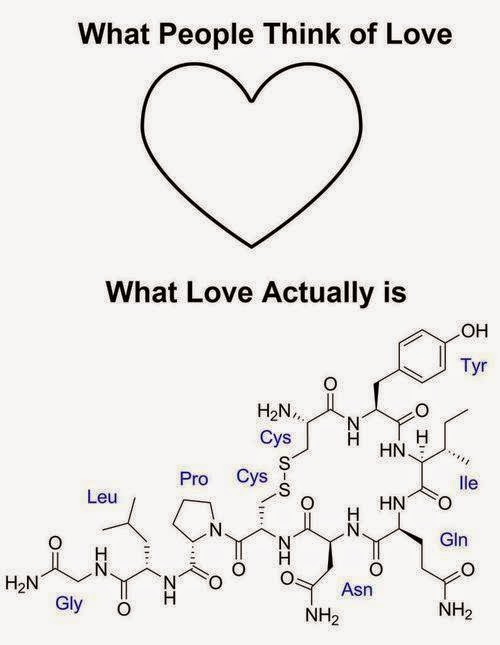
Scientists have also made great strides in elucidating the biochemical basis for love with the discovery of oxytocin, aka the “love hormone” or the “cuddle chemical”, which floods the brain during pair-bonding events, such as sex, childbirth, or eating a Reese's Peanut Butter Cup. In addition to forging pair bonds during sex, oxytocin appears to be instrumental in causing moms to love and care for their kids. Rat mothers given an agent that blocks oxytocin release disregard their newborn pups. There is even a review article on oxytocin written by a Dr. Love – no joke!

Lou Gramm of Foreigner once crooned, “I want to know what love is, I want you to show me.” Here you go, Lou.

So there you have it:  love is an evolutionary tactic that helps us propagate our genetic legacy. Let’s see Barry White work that into a song. It is not the most romantic answer, but remember…just because we know how the roller coaster works doesn’t make the ride any less thrilling.

*It should be noted that kin selection is seen in many species, and not just animals. For example, kin selection is seen in insects and even in plants!
Contributed by:  Bill Sullivan
(heart) Bill on Twitter.


Love TM (2014). Oxytocin, motivation and the role of dopamine. Pharmacology, biochemistry, and behavior, 119, 49-60 PMID: 23850525

van Leengoed E, Kerker E, & Swanson HH (1987). Inhibition of post-partum maternal behaviour in the rat by injecting an oxytocin antagonist into the cerebral ventricles. The Journal of endocrinology, 112 (2), 275-82 PMID: 3819639

Domingue, B., Fletcher, J., Conley, D., & Boardman, J. (2014). Genetic and educational assortative mating among US adults Proceedings of the National Academy of Sciences, 111 (22), 7996-8000 DOI: 10.1073/pnas.1321426111