Showing posts with label metamaterial. Show all posts

Tuesday, April 7, 2015

Star Trek Shields For Tanks


Last week we talked about shields for protecting
astronauts. This week shields against projectiles.
But they both can use plasma. The Star Trek
shields absorb or deflect energy, but a hunk of rock
would go right through. Read the post to find the
PASS plasma system – it might work better than
a Star Trek graviton shield.
Manny Pacquiao and Floyd Mayweather are going to have the next “fight of the century” on May 2, 2015 in Las Vegas. In "the sweet science" it’s all about hit and don’t get hit. But just as important is to minimize the damage when you do get hit.


We talked last week about how we are developing plasma shields to protect astronauts from space radiation. In a way, that’s the “don’t get hit” part in a nutshell. But space radiation isn’t trying to hit you; it’s just there, and so are you.

In Star Trek, the deflector shields were meant to avoid or minimize the damage of things meaning to destroy them. Like Mayweather’s right cross, photon torpedoes are sent with bad intentions.

Today let’s concentrate on emerging technologies to protect ourselves from things coming at us with bad intentions. In practical terms, using the technology we have right now, this would be most considered armor, but we are quickly moving to deflector shields. And some new armors now have deflecting capabilities.

One of the problems with plasma-based deflector shields is that you are relying on charges to deflect charged things away from you. Projectile weapons are often uncharged, although the metals in them can be charged. You would have to rely on destroying them with energy before they got to you rather than deflecting them away – and engineers are working on that.

Armor is designed to blunt the effect of some projectile, or an explosion + shrapnel. In most cases, the thicker the armor the better – like the traditional methods of shielding spacecraft from cosmic radiation. But newer types of armor are meant to protect in a more pro-active way.


Osmium is the densest naturally occurring
element. This makes it great as a contrast for
transmission electron microscopy. Here we see the
layers of myelin sheath around a neuron in the
brain. The dark lines are the lipid in each layer, as
fats pick up the osmium best.
After the refit of the Enterprise, Mr. Scott described a type of shield to be used that was more like armor. The replicator would produce a wall of very hard metal, I think they used a diburnium-osmium alloy. Then the transporter would project that alloy outside the ship’s hull, like a second layer of the hull. The Defiant had an ablative armor shield as well. Heck, so did Iron Man.

Ablative armor is a physical shield intended to be sacrificed. Its destruction dissipates much of the energy of the incoming projectiles or beam. We use ablative armor on returning vehicles from space. The heat shield tiles on the old Apollo missions were a form of ablative armor. The space shuttles had reusable tiles, but Orion is going back to an ablative system on the underside portion of the vehicle that will be hottest (4000˚ F).

A newer technology, called advanced ablative armor, will anticipate an attack and put additional armor where needed when needed. It's essentially a big catcher’s glove - stick it out where the pitch is coming.  Fullerene would be a good candidate for ablative armor – it is strong and light.

Real science has made more use of reactive armor than ablative armor. Reactive armor is also called active protection. This armor does something to protect the target, it doesn't rely on its material strength alone.

The earliest type of reactive armor was (and is) explosive. Explosive reactive armor (ERA) is meant to repel the killing mechanism of anti-tank missiles and rockets. High explosive armor piercing (HEAT) projectiles do their damage by breaking the outer hull by kinetic force, and then setting off an explosion that injects superheated copper through the hull and into the cab where the electronics and people are.


The army has been touting the effectiveness of ERA
since 2007, but the 2011 paper independently
confirmed it. This is a Bradley tank with the ERA
installed as an additive armor. It needs to be a certain
distance from the hull of the tank in order to protect it
maximally. Each individual box is an explosive unit, so
protection is precise to the area being struck.
ERA counters this by providing it’s own shape charged explosive. When the HEAT projectile pierces a thin metal plate on the outside of the tank, an explosion between it and the main hull of the tank throws a lot of energy out (away) from the hull. This counters the explosion and injection of liquid copper, repelling it away from the hull.

What you have to watch out for is tandem HEAT weapons, where one is fired right after the other at the same target point. The ERA charge which protects against the first won’t be there for the second.

ERA has been around since the late 1970’s, but there are new versions that actually sense the incoming round and set off the explosive armor BEFORE the rocket gets to the tank or the personnel carrier. Advanced ERA's been further improved by making the inside of the charge non-explosive, merely a rubber that turns to gas and expands the outer plate before the HEAT weapon hits. This is called bulge armor and is helpful against that second shot from a HEAT weapon, not just the first.

Electric reactive armors are being developed as well. One type uses two charged plates separated by an insulator. When a projectile penetrates the outer hull, the first plate touches the second. This completes an electrical circuit that releases a large electric charge and destroys the projectile.


A second type of electrical armor, developed by the British Defence Science and Technology Laboratory, uses a thin layer of a supercapacitor (a material that can store a large electrical charge over time) just internal to the outer armor. When a projectile is sensed by the radar/video/ESP of the armored target, it releases the charge from the capacitor onto the outer metal armor at the precise spot that is being targeted. This creates a huge EM field with flux lines spreading out from the target and acts as a temporary force field to repel/deflect/destroy the incoming projectile. Sounds a lot like a Star Trek deflector shield to me.

The American Defense labs have a version of reactive armor as well, called the American Iron Curtain. It's termed an Active Protection System (APS – because the military is the best in the world at creating initialisms). In this system, highly sophisticated radar and optical systems detect incoming projectiles and even classifies them as to their type and danger.

Projectiles are then fired down from the top of the targeted vehicle to intercept the incoming round and render it a dud. It doesn’t make them blow up early, it deactivates them with a projectile so they can’t blow up. They then just bounce of the hull. Iron Curtain was integrated into several different vehicle defense system in 2012 and 2013.


The left image is the vehicle based PASS system
ready to be deployed by the US Army as a nonlethal
crowd control device. On the right is the plasma
clouds produced by the primary laser. In the near
future, there will be hundreds of plasma cloud spots
and they will be able to form three dimensional shapes.
There is even a plasma-based shield weapon on the way. The United States Army Armament Research, Development and Engineering Center has developed a system called PASS (plasma acoustic shield system). Originally designed in 2007 to be a deterrent by creating a disorienting flash bang, the technology has come far in the past couple of years.

PASS uses a couple of high power lasers. The first creates an intense energy beam that strips the air molecules of their electrons, creating a plasma cloud. The plasma creation (very hot at the point of plasma, but dissipating rapidly as you move away, creates a small explosion, more like a loud bang.

A second laser then hits the plasma cloud just milliseconds later. The plasma absorbs the energy, expands rapidly which creates a shockwave and an even bigger bang. You can set this system up to fire repeatedly in a pattern, creating a wall of light and sound. Depending on the energy levels of the lasers, the wall will appear at various distances from the source.

Increase the energy of the wall (or whatever shape you want to project) and PASS can go from purely disorienting to lethal. Or it could disrupt incoming fire. This was the aim of the US Navy Plasma Point Defense System that was abandoned on the 2000’s, but advances present in PASS have made it feasible again. The PASS wall can’t be seen through and is impenetrable to infrared waves, but it carries some of the same drawbacks as Star Trek shields; you can’t see out either, and you couldn’t fire through it.

Finally, metamaterials may act as a defense shield some day. Structure in three dimensions gives metamaterials their characteristics instead of just the molecules of the material that makes them up. To give an example, cotton T-shirts have certain characteristics based on being made of cotton (soft, stretchy, can be dyed, shows off my guns, etc.). But a metamaterial T-shirt made from cotton might be able to deflect sound waves or do some other amazing things with EM waves, based on the shape that the cotton fibers are given in the shirt.


A soundproof room is a pretty good model for a absorbing metamaterial. 
The quietest room in the world is in Minneapolis. The cones at high 
angles bounce the sound into the other cones at 90˚ from the
first. Sound checks in but doesn’t check out. Metamaterials that absorb 
EM radiation do the same thing, they are just a billion times smaller, 
smaller than the wavelength of the light they absorb.
Recent papers have shown that certain metamaterials can act as energy absorbers. A group from Poland published a study in 2014 that used S-shaped metamaterials cells can absorb low frequency energy. The energy waves enter the S-shaped cells and bounce around until there energy is dissipated. Right now the potential use is for shielding electronics from EM pulses, but they could expand.

For an invisibility cloak, you would want the metamaterial to bounce the light around like a prism and then let it go after it passes around the object. But a cloaked object using an absorbing metamaterial would look black; the absorber doesn’t reflect the light so none returns to your eye. This would make for a bad cloak but a great shield - if you can find a way to keep the absorbed energy from destroying the shield.

Right now, the absorbers work in the low gigahertz range, so they absorb radio and microwaves, but a new study shows that some are being developed that absorb in the terahertz range. This is within infrared and visible light frequencies, the types of light used in high-energy laser weapons. Go a bit higher and perhaps we could absorb ultraviolet waves. But wouldn’t that just be sunscreen?

Next week – Mr. Data was an android, but at his most basic he was a robot with artificial intelligence. We’ve got rudimentary robots, but that AI thing is tougher.


Contributed by Mark E. Lasbury, MS, MSEd, PhD


Mayseless, M. (2011). Effectiveness of Explosive Reactive Armor Journal of Applied Mechanics, 78 (5) DOI: 10.1115/1.4004398

Yoo, Y., Zheng, H., Kim, Y., Rhee, J., Kang, J., Kim, K., Cheong, H., Kim, Y., & Lee, Y. (2014). Flexible and elastic metamaterial absorber for low frequency, based on small-size unit cell Applied Physics Letters, 105 (4) DOI: 10.1063/1.4885095

Grześkiewicz, B., Sierakowski, A., Marczewski, J., Pałka, N., & Wolarz, E. (2014). Polarization-insensitive metamaterial absorber of selective response in terahertz frequency range Journal of Optics, 16 (10) DOI: 10.1088/2040-8978/16/10/105104


Tuesday, February 24, 2015

Seeing Our Way to Invisibility


The Federation did not use cloaking devices, and
the Treaty of Algernon prevented them from
developing them. However, sometimes you have to
use what you have, so Enterprise did make use of a
stolen cloaking device to escape some Romulans in
The Next Generation series.
Gene Roddenberry believed in the idea of heroes and fair play. That’s why the Federation didn’t have cloaking devices. He stated in several interviews that, “heroes don’t sneak around.”


That’s why the Romulans and the Klingons had cloaking devices for their ships, but the Federation didn’t (with very rare exceptions). It's one of the few toys that came from the series that wasn’t a Federation invention or used by them. But it was awfully cool.

You hit a button and your ship disappears for everyone looking at it. The idea wasn’t original to Star Trek, J.R.R. Tolkein had it in the Lord Of The Rings, and it was a part of many folktales hundreds of years before he gave it to Frodo. Harry Potter’s cloak is probably a direct result of Frodo’s, although the movie Predator gave it a more scientific, not magical, feel that is more reminiscent of Star Trek.

The cloaking devices in the early Star Trek episodes were not perfect, you couldn’t fire weapons while cloaked and some tracking sensors could still find you. These are some of the same problems we're having with cloaking devices today.

Oh yes, we have cloaking devices.

The Klingon bird-of-prey projected it’s invisibility through its deflector shields; we don’t have anything that cool yet, but we can make things disappear under the right conditions. However, making a ship disappear to all wavelengths of electromagnetic radiation using something projected from the ship itself is beyond us as of yet. Let’s see what we can do.


The electromagnetic spectrum is all around us, we
see with only a very small part of it. The longer the
wavelength, the lower the energy, so gamma rays are
very powerful, and radio waves can’t hurt you unless
we’re talking about your ears.
First of all, how do we sense things that are in front of us, or even a little to the side of us? Our eyes use visible light, just a small portion of the entire electromagnetic spectrum. Visible light waves from the sun or some other source strike the object; some are absorbed and some bounce off. A few of the bounced rays make it to our retina. They are the ones we decode into a shape. The object might absorb all light but red, so only the red waves bounce off and make it to our eye. We see the object as red.

But there are so many more types of waves than just visible light. Infrared waves are longer and lower energy than visible light. Heat sources give off infrared waves, so this is how you can find people in the dark with night vision goggles. Radio waves are even lower energy, while microwaves for radar are in between infrared and radio.

Higher energy waves are on the other side of the visible spectrum; things like ultraviolet, X-rays, and Hulk-producing gamma rays. All the different types of waveforms can be detected by some kind of detector or another. They all give clues to the fact that something is out there. Star Trek cloaking devices masked all of them eventually, but we’ve only gotten to the point of hiding from a few wavelengths at a time.

As with most scientific or technological advances, first we have many of ways to try it, and we finally settle on what works best. Remember VHS vs. Betamax? As our knowledge increases, we will hone in on one or two ways to make these cloaks work, but for now, there’s a bunch.

This is not to say that we haven’t been hiding things in plain sight for a long time. Camouflage is an ancient practice, something we stole from nature. Active camouflage is a little more tech-y and recent. This technique allows the camouflage to change as the background changes.


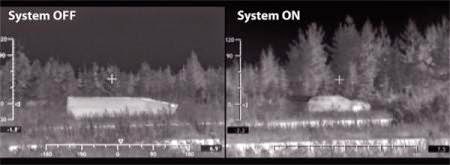
The Adaptiv technology uses hexagonal panels on the
sides and turret of tanks to project an incorrect heat
signature. To an infrared scope, they can look like a
station wagon or truck.  This is one type of active
camouflage.
One type of active camouflage is a way to project the background onto a screen or cover over the object. They have even gone so far as to make cloaks that capture background on tiny cameras in the back and project that image from pixels on the opposite side.

However, when the object moves, there is a blur as the cameras catches up to the new background. Plus, like with your TV, it only works very well when you are directly in front of it. Nobody wants to be the guy watching the Super Bowl from the uncomfortable chair that’s at a 45˚ angle to the TV screen.

There is also holographic camouflage, so that as you move past the object, the background appears to move with you. Better, but still not great. And these examples are for just visible light; nothing about a hologram projected on a sheet is going to hide your heat signal from a guy with infrared night specs. The new Adaptiv system allows tanks to project a different heat signature than they normally would (see picture above).


A metamaterial is any solid that derives its properties
from its structure, not its composition. It is how they are
made in 3-D, together with what they are made of, that
allows them to cancel out waves or bend them. On the
right is a significant feature of some metamaterials, a
negative refractive index. Regular materials can reflect
a beam more than 90˚ to the face of the object,
metamaterials can, and this is how they can bend the light
around objects.
Now we have moved on to true cloaking, which is more passive than active camouflage. The methods with which we are currently hiding objects are mostly defined by which wavelengths of radiation we want to hide them from. The first real cloak of invisibility was demonstrated in 2006, and hid a small object or part of an object from some microwave wavelengths. Other cloaks hide things only from radio waves.

Many of the newer techniques bend light around the object, sort of like a stone in a stream. The water comes back together on the other side and moves on as if the object weren’t there. Same with light rays that bounce off the background. Using proper technology, they can be made to travel around the object being cloaked and travel to your eye as if it wasn’t even there.


The mantle cloak technique uses a very thin layer of
metamaterial to bend light rays or cancel them out. Harry
Potter might have been hidden better, but I like our chances
with science better than magi
True cloaking makes use of either traditional or some complex surfaces called metamaterials (or superlenses made of metamaterials). See the picture above to learn a little about metamaterials but I suggest that quite a bit of reading is necessary to make you feel like you understand them at all. I’m not to that point yet.

The metamaterials offer several different ways to hide something, like plasmonic cloaking, where the light scattered by an object is detected by the cloak. The clock then emits a canceling wave at precisely the same length but 180˚ out of phase. The two waves cancel each other out and it is as if no light was bounced toward your eye or your detector. Other metamaterials don’t cancel the signal, but truly bend it around the object as described above.

A mantle cloak is thinner, using a metamaterial screen just a few millimeters thick to produce the antiphase radiation that cancels out whatever strikes it. This was demonstrated in 2013 by Andrea Alu from the University of Texas, just as the plasmonic cloak was a few years previous. The advantage is that the thinner the cloak or mantle, the broader the range of wavelengths that it could cancel out.


The Rochester cloak uses the mirrors of different focus
lengths to bend visible light rays. Check out this website to
make one yourself. While cloaks in the visible range are the
biggest show, the military or security will be interested in
cloaks of broad wavelengths, not just visible light.
Several groups have demonstrated the use of a  traditional lens, sometimes called a Rochester Cloak because they were developed at the University of Rochester in New York. All you need is two sets of lenses with two different focal lengths (a and b); use "a" then "b" to bend the light around, then "b" and "a" to bend it back. This isn’t really dynamic cloaking because it's stationary. Whatever is behind that lens at that moment will disappear. We need to be able to have either huge sets of lenses or make the air act like a lens so that something large and moving could be cloaked.

A big problem that we must overcome to mimic Star Trek cloaking is that fictional ships can scan and see what is out there via emission of their own probes or detectors, we can't do that yet. With current technologies, the object is covered or masked, so it can’t emit anything or see anything around it. Most current cloaks work by absorbing or channeling EM waves, so if the cloaked object emits anything, it can be detected.

As Frodo could see through the weave of his cloak, we need to be able to look out from a cloaked object and see what we want, or even send out some energy to detect things that might be out there. There is limited advantage to a cloaked ship that is ostensibly blind itself. However, 2012 experiments did develop a plasmonic cloak that detected light, so over a very narrow range it was an invisible device that could see.


Another low-tech cloak is using mirrors, but again, you
have to be positioned exactly right for them to give you
the right image. Plus, this is just for visible light, a true Star
Trek cloak would mask all wavelengths of
electromagnetic radiation.
Another problem with cloaked materials was described in a 2013 paper. Despite being “invisible” to some EM wavelengths, the cloaks may increase the scatter in the other wavelengths by the cloaked object so that the total scatter is greater than that of the uncloaked object alone.

In addition, the cloaks themselves usually scatter light, so even though the object being cloaked is hidden, the cloak itself might be detected! The authors suggest that there could be a passive solution using superconductors, or that mixed metamaterials could scatter the waves bouncing off the object to be hidden and the cloak.

Next week, how about looking at our versions of phasers – we do have them, just not small enough to be hand held.


Contributed by Mark E. Lasbury, MS, MSEd, PhD
As Many Exceptions As Rules


Choi, J., & Howell, J. (2014). Paraxial ray optics cloaking Optics Express, 22 (24) DOI: 10.1364/OE.22.029465
 
Fan, P., Chettiar, U., Cao, L., Afshinmanesh, F., Engheta, N., & Brongersma, M. (2012). An invisible metal–semiconductor photodetector Nature Photonics, 6 (6), 380-385 DOI: 10.1038/nphoton.2012.108
 
Soric, J., Chen, P., Kerkhoff, A., Rainwater, D., Melin, K., & Alù, A. (2013). Demonstration of an ultralow profile cloak for scattering suppression of a finite-length rod in free space New Journal of Physics, 15 (3) DOI: 10.1088/1367-2630/15/3/033037