Showing posts with label hormones. Show all posts

Thursday, February 12, 2015

Happy Valentine's Day! What Is Love, Anyway?

Many an ‘80s band has pondered the timeless question:  Howard Jones asked “What is Love”, Foreigner lamented “I Want To Know What Love Is”, and both Survivor and Whitesnake wondered “Is This Love”, just to name a few. Recently, a pair of skeletons was discovered in Leicestershire, England, holding hands for the past 700 years. Well, either that or they were thumb-wrestling enthusiasts.

"I wanna hold your hand"
It is hard for us humans to imagine a world without love, but the universe has been going about its business with complete dispassion for billions of years. The appearance of life on Earth did little to change that at first, but after a couple billion years, life forms began to emerge with brains sophisticated enough to make love possible. So it is clear that love is not requisite for life; for every animal that can experience love, there are billions of bacteria living with that animal that do just fine without it.

Many of Earth’s creatures thrive without any need for love.

Granted, bacteria divide asexually, so there is no need to wine and dine a partner who is probably not going to return your 33 calls anyway. You might think that love is needed for sex, but many life forms that have sex, including parasites, plants, insects, and frat boys, do so without love, further begging the question:  why does love exist?

At first sight, love would seem to be counterintuitive to evolution, which is often characterized as the “blind watchmaker” driven by “selfish genes” tinkering to build the fittest survival machine. However, love can confer extraordinary benefits to its practitioners, which is especially important when their offspring are unfit to survive on their own after birth. Most scientists agree that love evolved to prompt species to protect their offspring (this is known as kin selection*), and this altruistic behavior often extends to others who share similar genes. A recent study from April of this year has indeed shown that spouses tend to have similar DNA, and we reported a study a few weeks ago about friends having similar DNA. In other words, an objective analysis reveals that love is a stealthy manipulation orchestrated by selfish genes in order to trick us into protecting their legacy.

Certain dating web sites are capitalizing on the discovery that spouses share highly similar DNA. You can find your genetic soul mate by viewing the genes of potential partners as you check out what they look like in tight jeans.

Back in the 80s we didn’t have technology that could identify our genetically compatible companion, so we had to rely on the wisdom of the great philosopher Sammy Hagar to teach us how we know “When It’s Love”.


Scientists have also made great strides in elucidating the biochemical basis for love with the discovery of oxytocin, aka the “love hormone” or the “cuddle chemical”, which floods the brain during pair-bonding events, such as sex, childbirth, or eating a Reese's Peanut Butter Cup. In addition to forging pair bonds during sex, oxytocin appears to be instrumental in causing moms to love and care for their kids. Rat mothers given an agent that blocks oxytocin release disregard their newborn pups. There is even a review article on oxytocin written by a Dr. Love – no joke!
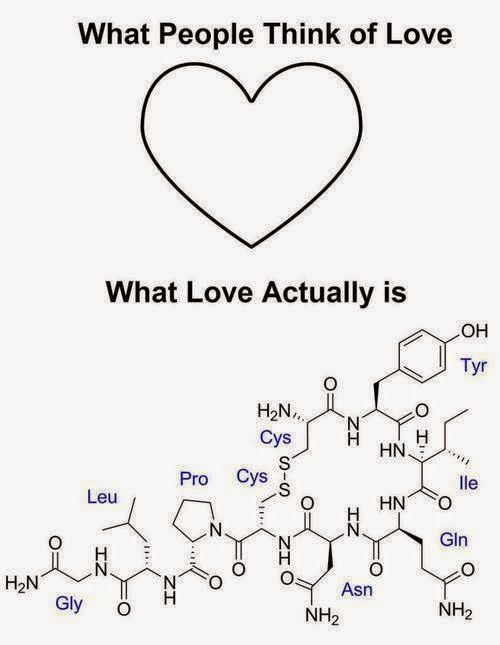
Lou Gramm of Foreigner once crooned, “I want to know what love is, I want you to show me.” Here you go, Lou.

So there you have it:  love is an evolutionary tactic that helps us propagate our genetic legacy. Let’s see Barry White work that into a song. It is not the most romantic answer, but remember…just because we know how the roller coaster works doesn’t make the ride any less thrilling.

*It should be noted that kin selection is seen in many species, and not just animals. For example, kin selection is seen in insects and even in plants!
Contributed by:  Bill Sullivan
(heart) Bill on Twitter.


Love TM (2014). Oxytocin, motivation and the role of dopamine. Pharmacology, biochemistry, and behavior, 119, 49-60 PMID: 23850525

van Leengoed E, Kerker E, & Swanson HH (1987). Inhibition of post-partum maternal behaviour in the rat by injecting an oxytocin antagonist into the cerebral ventricles. The Journal of endocrinology, 112 (2), 275-82 PMID: 3819639

Domingue, B., Fletcher, J., Conley, D., & Boardman, J. (2014). Genetic and educational assortative mating among US adults Proceedings of the National Academy of Sciences, 111 (22), 7996-8000 DOI: 10.1073/pnas.1321426111

Monday, August 25, 2014

Chinese Food And The One Hour Dilemma


Chinese food is a staple of the American city. Here marks
the grand reopening of a restaurant in Albany, NY. OK, so
they don’t know the marketing angle so well. The interesting
thing to me is the name of the restaurant – CCK – which is
one of the satiety hormones implicated in why eating Chinese
food makes you hungry so soon afterwards.
Chinese food is one of America’s favorite meals. In the New York City metropolitan area there are more than 1783 Chinese restaurants. That’s one restaurant for every 250 Chinese people in the city.

Eating Chinese food can be spicy or bland, rice or noodles, but it's always filling. The problem is that you supposedly feel hungry soon after eating. Could it be a devilishly sly plan to get you to order more wontons?

The truth is that some people do feel hungry soon after a Chinese meal, enough people to keep the old saying in our lexicon.

The first published instance of the Chinese food dilemma was in a 1934 article in the Golden Book. Nowadays the problem is called Chinese Food Hunger, or CFH for short. Can we pinpoint why people get hungry after a plate of Chinese food before the next mealtime?

Getting hungry in scientific terms is an issue of satiety. A hunger problem is really a satiety problem; less satiety = more hunger. This idea led to the creation of a satiety index by Holt et al., in 1995, ie. just how full certain foods make you feel. The index uses the same number of calories of different foods and converts the self-reported feelings of fullness over time by the participants to a number scale.

Chinese food from different parts of China uses either rice or noodles as a starch. These carbohydrates have satiety indices of 130 and 119, respectively. Potatoes, on the other hand, have a satiety index of 323, the highest of any food tested. This leads to one hypothesis of CFH - Americans think Chinese food makes them hungry sooner because they're comparing it to potato based meals.

People have been eating fewer potatoes in the last 30-40 years, McDonald’s French fries not withstanding. This may account for why many people think we talk about CFH less than we used to. However, a 2013 study showed that despite the high satiety of potatoes, they didn't significantly reduce the amount of food that was consumed later as compared to other meals. So maybe it means nothing.


You can see that hunger and fullness feelings are well
controlled and complex. Basically, the more green input,
the fuller you will feel and the less you will seek out food.
This is just one of the ways our brain tricks us into wanting
the things that we need.
The regulation of satiety and hunger is controlled by many hormones. Several gastrointestinal hormones act in satiety. Cholecystokinin (CCK), pancreatic polypeptide, peptide YY, glucagon-like peptide-1, oxyntomodulin – these all work to increase satiety and decrease food intake. Ghrelin, on the other, is produced by select cells of the stomach and pancreas and acts to decrease satiety and increase food intake. These signals are monitored and regulated in the hypothalamus and arcuate nucleus of the brain – the so-called hunger centers.

Leptin works in the opposite direction as ghrelin. Leptin hormone is produced by fat cells (adipocytes). It stimulates hunger when fat cells are being used as energy source, as when caloric intake is low. Leptin increases satiety when caloric intake is high - more leptin is put out by fat cells. Leptin also acts in reward centers; more leptin (more fat = a more fed situation) decreases the reward felt by eating food, and reduces the craving for reward of food. These are complex pathways.

So what is it in Chinese food that affects the levels of satiety hormones?

Monosodium glutamate (MSG) is a common whipping boy. People have said MSG is unhealthy, raises blood pressure, and is toxic. Some people really do have a bad reaction to MSG, referred to as Chinese Restaurant Syndrome (don’t confuse CFH and CRS).  In CRS, suffers show reddened skin, headache, chest pain, sweating, and numbness. But most people don’t have a problem with MSG and survive Chinese food just fine.


MSG can lead to facial flushing like on the left. However, the
reduction in MSG use has not eliminated the problem for
some people. In many foods, the MSG has been replaced with
another flavor enhancer called E635. This is a combination of
two ribonucleotides (IMP and GMP) with two sodium molecules
on each. E635 can lead to similar or worse problems as MSG in
susceptible people. The smile on the right is after she discovered
how to avoid her problem foods.
Still, the vast majority of Chinese restaurants have cut back on MSG. This is another reason why some people say that complaints about Chinese food making them hungry sooner have decreased – because MSG is the culprit and less MSG is being. Not a very scientific determination.

A study in 2011 showed that MSG does not alter ghrelin, GLP-1 or insulin levels, and actually brings more distention of one end of the stomach, so it probably makes you feel more full rather than less full.

Don't worry, there are several other possible culprits. For one thing, most Chinese natives eat less meat as a part of the meal as compared to Westerners. Do low protein meals lead to decreases in satiety hormones or increases in hunger hormones? Probably not, a 2014 study showed that satiety hormone profiles were similar between good vegetarian diets and high meat diets.

How about low fat meals – less red meat and processed foods could also result in low fat Chinese meals.  Does eating low fat mean you’ll be hungrier sooner?

One problem with protein and/or fat hypotheses is that Chinese food as served in American restaurants today is not very Chinese. They use more meat, more fat, and more sauce than would be included in traditional Chinese meals. So I don’t think we can use them to explain CFH.

The idea of glycemic index is very hot right now. Originally developed to try and help diabetics better manage their blood sugar levels, weight loss gurus now lament that high glycemic index foods put the sugar into your blood very quickly and then cause you to crash to lower blood sugar levels sooner. This leads to overeating and weight gain. Eating low glycemic index foods (like vegetables and fruits) means that you don’t digest food as fast, and stay full longer.


Here are examples of high and low glycemic index foods and
their effects on blood sugar levels. Note that high GI foods don’t
crash your blood glucose at two hours, it’s just a little lower.
Might this be enough to increase appetite?
Some recent studies indicate low GI meals result in more CCK and didn’t increase ghrelin. This would suggest that Chinese foods high in vegetables would maintain satiety longer rather than make you hungry sooner. However, one 2008 study in overweight women showed that high GI foods led to more satiety hormones and less hunger. But again, American Chinese food uses lots of rice and sugary sauces, so it is has a much higher GI than traditional Chinese food.

Final answer – we don’t know why eating Chinese food results in being hungry again so soon. Science can be frustrating. Maybe it really is just a phrase that snuck into our language and gets repeated even though it’s not real. Sort of like the misconception that we only use 10% of our brain.

I suggest a rigorous, government-funded study. First to be determined is whether the satiety index of a Chinese food meal is significantly lower than that of an Italian, Mexican, or American meal. Step two would be to determine the effects of every Chinese food on the satiety and hunger hormones. If no food alters hormone levels markedly, then a study of pleasure center activation would be necessary. Any way you cut it, we’re going to need a lot of chopsticks, fortune cookies and small white cardboard boxes.


contributed by
Mark E. Lasbury MS, MSEd, PhD
As Many Exceptions As Rules


Neacsu M, Fyfe C, Horgan G, & Johnstone AM (2014). Appetite control and biomarkers of satiety with vegetarian (soy) and meat-based high-protein diets for weight loss in obese men: a randomized crossover trial. The American journal of clinical nutrition, 100 (2), 548-558 PMID: 24944057 

Geliebter A, Lee MI, Abdillahi M, & Jones J (2013). Satiety following intake of potatoes and other carbohydrate test meals. Annals of nutrition & metabolism, 62 (1), 37-43 PMID: 23221259
 
Boutry C, Matsumoto H, Airinei G, Benamouzig R, Tomé D, Blachier F, & Bos C (2011). Monosodium glutamate raises antral distension and plasma amino acid after a standard meal in humans. American journal of physiology. Gastrointestinal and liver physiology, 300 (1) PMID: 21030612